3.2 - Heat of Reaction
Types and Calculation of Heat of Reaction
Heat of reaction is named after the reaction involved: heat of precipitation, heat of displacement, heat of neutralisation or heat of combustion.
The heat transferred to or from a solution is calculated by:
where is heat in J, is mass in g, is specific heat capacity in , and is temperature change in .
- Write the balanced or ionic equation and determine the reacting amount or product formed, .
- Calculate and then .
- Convert J to kJ and scale the heat change to one mole of the quantity named in the definition.
- State in , using a negative sign for heat released and a positive sign for heat absorbed.
| Heat of reaction | Mole quantity used for |
|---|---|
| Precipitation | Precipitate formed |
| Displacement | Metal displaced |
| Neutralisation | Water formed |
| Combustion | Fuel burnt |
For aqueous-solution calculations, assume density , specific heat capacity , no heat loss to the surroundings and no heat absorbed by the apparatus.
Heat of Precipitation
Heat of precipitation is the heat change when one mole of precipitate is formed from its ions in aqueous solution.
Thus, forming one mole of barium sulphate precipitate releases .
- Insoluble salts form precipitates through double decomposition, which involves heat change.
- Barium sulphate is a white, insoluble precipitate used in contrast media to make the digestive tract, stomach and intestines visible on X-rays.
Worked pattern: Mixing each of and raises the temperature from to .
Precipitation measurements
- The comparison uses each of and , or and , with two lidded polystyrene cups, a measuring cylinder and a thermometer.
- Initial temperatures are taken after two minutes; the solutions are mixed quickly and carefully, covered and stirred, and the highest mixture temperature is measured.
- Operational definition: Adding sodium chloride solution to silver nitrate solution to form one mole of silver chloride precipitate increases the thermometer reading.
- Precaution: Silver nitrate solution can stain skin and clothing black.
Calculating temperature rise from heat of precipitation: each of and form with .
Heat of Displacement
Heat of displacement is the heat change when one mole of a metal is displaced from its salt solution by a more electropositive metal.
The brown copper deposit and fading blue solution show that iron displaces copper from copper(II) sulphate solution.
Worked pattern: Excess magnesium is added to of and the temperature rises by .
Comparing displacement of copper
- The comparison uses solution, magnesium powder and zinc powder, with a lidded polystyrene cup, thermometer, measuring cylinder and spatula.
- The apparatus shows metal powder mixed with copper(II) sulphate solution, a thermometer in the covered cup, stirring and a copper deposit.
- Temperature change is used to calculate the heat of displacement for each metal.
Heat of Neutralisation
Neutralisation is the reaction of an acid with an alkali to produce only salt and water. It is exothermic.
Heat of neutralisation is the heat change when one mole of water is formed by neutralisation between an acid and an alkali.
For a strong monoprotic acid and strong alkali:
| Reactants | Typical heat of neutralisation () |
|---|---|
| Strong acid + strong alkali | |
| Weak acid + strong alkali | |
| Strong acid + weak alkali | |
| Weak acid + weak alkali |
Weak acids and weak alkalis ionise only partially. Some heat released by neutralisation is absorbed to complete their ionisation, so the measured heat released is lower; the weak-acid–weak-alkali combination has the lowest value.
A diprotic strong acid produces two moles of per mole:
The equation releases twice the heat because it forms two moles of water, but the heat of neutralisation remains per mole of water.
Strong monoprotic acids and strong alkalis share the same ionic neutralisation reaction; for example:
Experiment 3A — comparing acid and alkali strengths
- Aim: Compare heats of neutralisation for strong acid–strong alkali, weak acid–strong alkali, strong acid–weak alkali and weak acid–weak alkali.
- Part A hypothesis: A strong acid reacting with a strong alkali produces a higher heat of neutralisation than a weak acid reacting with a strong alkali.
- Materials: , , and solutions.
- Apparatus: Lidded polystyrene cups, thermometer and measuring cylinder.
- Part A variables: Manipulated — hydrochloric acid or ethanoic acid; responding — heat of neutralisation; fixed — volume and concentration of sodium hydroxide solution.
Part A procedure:
- Measure each of hydrochloric acid and sodium hydroxide solution into separate polystyrene cups.
- Put a thermometer into each solution and record both initial temperatures.
- Pour the acid quickly and carefully into the alkali, stir with the thermometer and record the highest temperature.
- Repeat with ethanoic acid replacing hydrochloric acid.
Measurements: Initial acid and alkali temperatures, their average temperature, highest mixture temperature and temperature rise. Use the average starting temperature to find the temperature rise. The four reacting pairs are , , and .
Worked calculation: each of ethanoic acid and sodium hydroxide solution start at and reach .
Heat of Combustion
Heat of combustion is the heat released when one mole of a substance is completely burnt in excess oxygen.
Experiment 3B — heat of combustion of alcohols
- Aim: Determine and compare the heat of combustion of methanol, ethanol, propanol and butanol.
- Hypothesis: The more carbon atoms per alcohol molecule, the higher the heat of combustion.
- Manipulated variable: Type of alcohol. Responding variable: Heat of combustion. Fixed variable: Volume of water.
- Materials: Methanol, ethanol, propanol, butanol and water.
- Apparatus: Copper can, tripod stand, pipe-clay triangle, thermometer (–), measuring cylinder, spirit lamp, electronic balance, wind shield and wooden block.
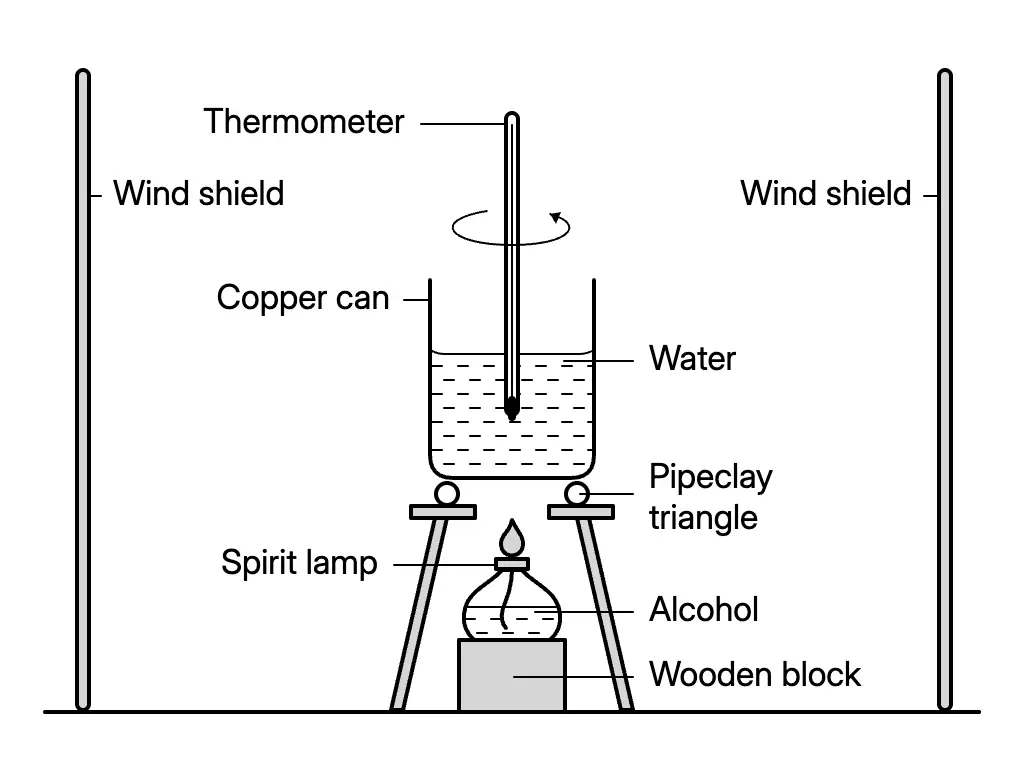
- Place of water in the copper can and record its initial temperature.
- Fill a spirit lamp about three-quarters full with methanol; weigh the lamp, lid and fuel.
- Light the lamp beneath the can. Keep the flame touching the can, shield it from wind and stir the water continuously.
- Extinguish the flame after the water temperature rises by ; record the highest temperature.
- Immediately reweigh the lamp to obtain the mass of fuel burnt.
- Repeat with ethanol, propanol and butanol. Calculate moles burnt, absorbed by the water and for each alcohol.
Safety and accuracy: Alcohols are volatile and highly flammable. Keep the flame touching the copper can, use the wind shield, stir continuously and weigh promptly after combustion.
Complete combustion of alcohol produces carbon dioxide and water. As the number of carbon atoms per molecule increases, more carbon dioxide and water molecules form and more heat is released. Successive alcohols differ by one group, so the increase in heat of combustion is approximately regular.
Calculation example:
Heating of water by requires:
Answer practice questions to test your knowledge
Practice