2.3 - Chemical Properties and Interconversion of Compounds between Homologous Series
Chemical Properties of Alkanes
- Alkanes are saturated hydrocarbons containing strong C–C and C–H single bonds. They are relatively unreactive because much energy is needed to break these bonds.
- Their main reactions are combustion and substitution.
Combustion
- Complete combustion in excess oxygen produces carbon dioxide and water and releases much heat, making alkanes suitable fuels:
- In limited oxygen, incomplete combustion produces poisonous carbon monoxide or carbon particles (soot), together with water:
- Within the alkane series, more carbon atoms produce more soot.
- Balance combustion equations in the order carbon → hydrogen → oxygen; fractions may be used for the oxygen coefficient.
- Methane is the main component of natural gas and is also produced when organic waste decomposes without oxygen. Its flammability can cause fires at landfills and peatlands.
Substitution
- In sunlight or ultraviolet light, an alkane reacts with a halogen such as chlorine or bromine. Hydrogen atoms are replaced one at a time by halogen atoms.
- UV light breaks the halogen–halogen bond. Chlorination of methane proceeds successively:
- The successive products are chloromethane, dichloromethane, trichloromethane and tetrachloromethane.
Chemical Properties of Alkenes
- Alkenes are more reactive than alkanes because most reactions occur at their C=C double bond.
- They undergo combustion, addition and addition polymerisation.
Combustion: Complete combustion produces carbon dioxide and water. In insufficient oxygen, incomplete combustion produces carbon particles or poisonous carbon monoxide, together with water. Alkenes burn more sootily than corresponding alkanes because they have a higher percentage of carbon by mass.
Addition: An atom or group is added to each carbon of C=C, converting the double bond into a single bond.
| Reaction and condition | Product / observation |
|---|---|
| Hydrogenation: , Ni or Pt, | corresponding alkane; |
| Halogenation at room conditions | dihaloalkane; ethene decolourises brown bromine water to form 1,2-dibromoethane |
| Addition of dry hydrogen halide at room temperature | haloalkane; |
| Hydration: steam, , , | alcohol; |
| Oxidation with acidified | purple solution decolourises; ethene forms ethan-1,2-diol |
- Catalytic hydrogenation converts vegetable oils into solid fats in margarine manufacture; hydration of ethene is an industrial method of producing alcohol.
Addition polymerisation
- Many alkene monomers join at their double bonds to form a long-chain polymer.
- At and , ethene forms polyethene:
Comparing an Alkane and an Alkene
Aim: Compare hexane, , and hexene, , by flame sootiness and reactions with bromine water and acidified potassium manganate(VII).
- Problem investigated: Whether an alkane and an alkene burn with the same quantity of soot.
- Hypotheses: Hexene burns with a sootier flame; hexene decolourises brown bromine water and purple acidified , whereas hexane causes no colour change.
- Manipulated variable: Hexane or hexene. Responding variables: soot quantity or reagent colour change. Constant variable: volume of hydrocarbon.
- Materials/apparatus: Hexane, hexene, wooden splinter, matches, filter paper, bromine water in 1,1,1-trichloroethane, acidified , evaporating dish, test tubes, measuring cylinder and dropper.
Method and results
- Burn of each hydrocarbon separately in an evaporating dish and compare soot deposited on filter paper. Hexene produces more soot.
- Add two to three drops of bromine water in 1,1,1-trichloroethane to of each hydrocarbon in separate test tubes and shake. Hexene decolourises it; hexane does not.
- Add two to three drops of acidified to of each hydrocarbon in separate test tubes and shake. Hexene decolourises the purple solution; hexane does not.
- Hence an unsaturated hydrocarbon is operationally identified by decolourising bromine water or acidified under these conditions.
- Precaution: Wear safety goggles during the combustion test.
- A higher percentage of carbon by mass produces a sootier flame. For propane and propene:
Preparation and Chemical Properties of Alcohols
Preparation of ethanol
- Fermentation: In the absence of oxygen, zymase in yeast converts glucose from sugar or starch into ethanol and carbon dioxide. Ethanol is purified by fractional distillation.
- Hydration of ethene:
Laboratory preparation by fermentation
- Aim: Prepare ethanol by fermenting glucose.
- Materials: glucose, yeast, distilled water, limewater and filter paper.
- Apparatus: Conical flask, beaker, measuring cylinder, round-bottom flask, delivery tube and stopper, test tube, thermometer, fractionating column, Liebig condenser, retort stand, wire gauze, Bunsen burner, tripod stand, rubber tubing, filter funnel and glass rod.
Procedure
- Mix the glucose with the distilled water in a conical flask, add the yeast and stir evenly.
- Fit the stopper and delivery tube, with the tube end immersed in limewater.
- Leave at for three days, then filter the mixture.
- Transfer the filtrate to a round-bottom flask with a fractionating column and Liebig condenser. Heat in a water bath, collect the distillate at , and record its colour and smell.
- Carbon dioxide turns limewater cloudy. The distillate is colourless, volatile ethanol.
Reactions of alcohols
Combustion: Alcohol burns with a blue, non-sooty flame in excess oxygen and releases much heat.
Oxidation: Acidified potassium manganate(VII) or acidified potassium dichromate(VI) oxidises ethanol and propan-1-ol to their corresponding carboxylic acids. Purple becomes colourless; orange becomes green.
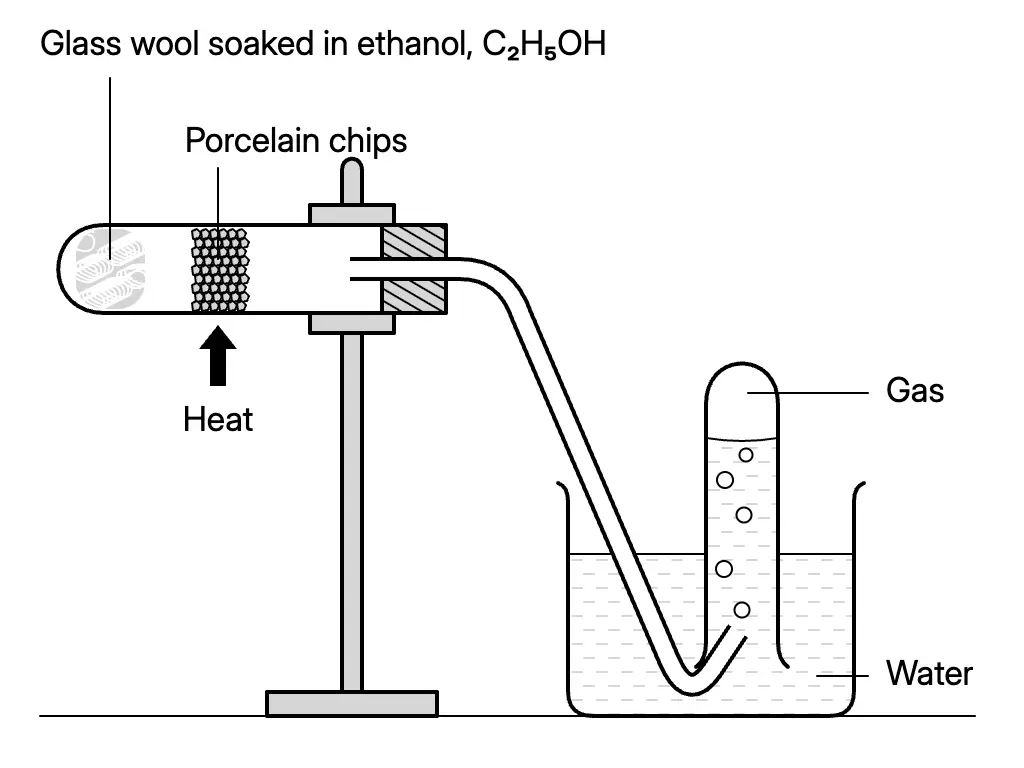
Dehydration: Passing alcohol vapour over strongly heated porcelain chips, aluminium oxide or alumina, or using concentrated sulphuric acid, removes water and produces the corresponding alkene.
- Dehydration removes –OH and H from adjacent carbon atoms to form water. Methanol cannot form an alkene by this reaction because it has only one carbon atom; the alkene general formula starts at .
- Propan-1-ol similarly forms propene:
- The ethene formed burns with a yellow sooty flame and decolourises bromine water and acidified .
Investigation of ethanol oxidation and dehydration
- Aim: Study the chemical properties of ethanol.
- Materials: Ethanol, porcelain chips, glass wool, potassium dichromate(VI) solution, potassium manganate(VII) solution, concentrated sulphuric acid, blue litmus paper and bromine water.
- Apparatus: Test tubes, boiling tube, stopper with delivery tube, retort stand, test tube holder, Bunsen burner, measuring cylinder, dropper and beaker.
- Precaution: Concentrated sulphuric acid is corrosive and must be handled carefully.
Oxidation procedure
- Add of potassium dichromate(VI) solution and ten drops of concentrated sulphuric acid to a boiling tube; warm gently.
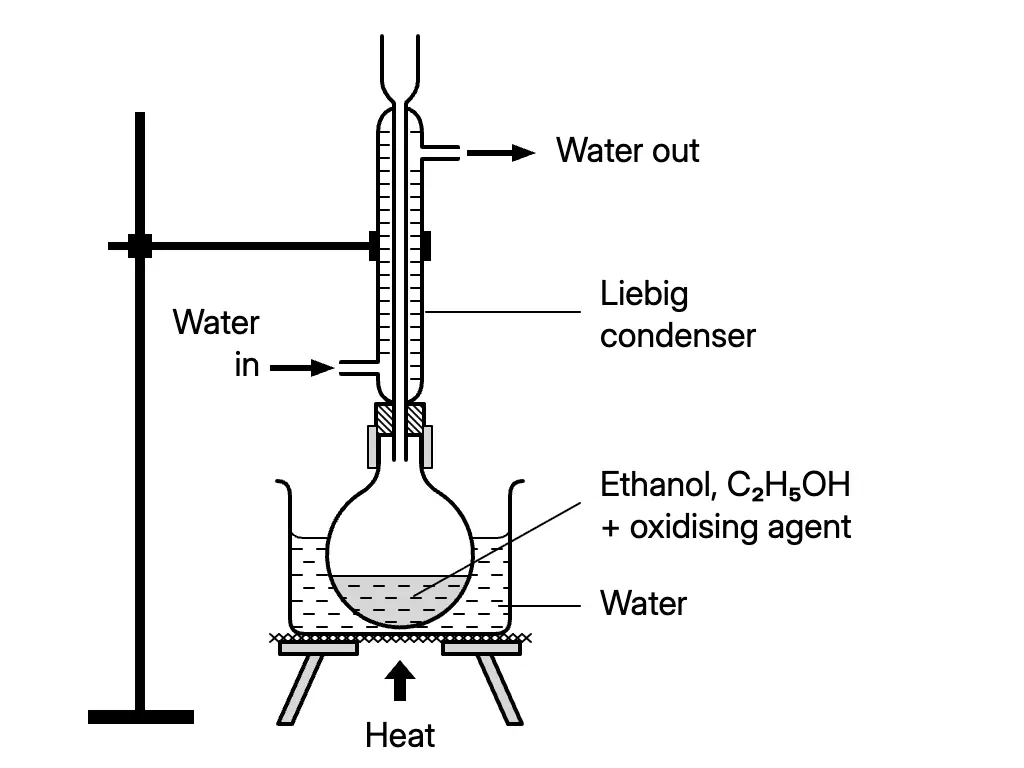
- Add of ethanol dropwise. Attach the delivery tube and heat gently until the mixture boils.
- Collect the distillate in a test tube cooled in a beaker of cold water and test it with blue litmus paper.
- Repeat with potassium manganate(VII) solution. Record reagent colour changes and the distillate’s colour, smell and litmus effect.
- Conclusion: Oxidation of ethanol produces ethanoic acid. The oxidising-agent colour changes are given above; the acid turns blue litmus red.
Dehydration procedure
- Soak glass wool in of ethanol at one end of a boiling tube and place porcelain chips in the middle.
- Heat the chips strongly and the glass wool gently so that ethanol vapour passes over the hot chips.
- Collect two test tubes of gas over water. Shake one with a few drops of bromine water and the other with acidified potassium manganate(VII).
- Conclusion: Ethanol forms ethene, which decolourises both reagents.
- Reflux preparation of ethanoic acid: An upright Liebig condenser returns condensed ethanol to the reaction flask, allowing it to react completely with the oxidising agent.
Chemical Properties of Carboxylic Acids
- Carboxylic-acid reactions are determined by the carboxyl group, –COOH.
- Ethanoic acid is a weak acid and ionises partially in water:
| Reaction | Example equation |
|---|---|
| Acid + base → carboxylate salt + water | |
| Acid + metal carbonate → salt + water + carbon dioxide | |
| Acid + metal → salt + hydrogen |
Investigation of ethanoic acid reactions
- Aim: Study the chemical properties of ethanoic acid.
- Problem investigated: Whether ethanoic acid reacts with a metal, a metal oxide and a metal carbonate.
- Materials: ethanoic acid, magnesium ribbon, sodium carbonate powder, copper(II) oxide powder and limewater.
- Apparatus: Test tube rack, stopper with delivery tube, Bunsen burner, test tube holder, boiling tube, wooden splinter and glass rod.
- The three reactions yield magnesium ethanoate and hydrogen; sodium ethanoate, carbon dioxide and water; or copper(II) ethanoate and water, respectively. These illustrate reactions with a metal, a metal carbonate and a base.
Esterification and Esters
- A carboxylic acid reacts with an alcohol, on heating with concentrated sulphuric acid as catalyst, to form an ester and water. This is esterification.
- Water forms from –OH removed from the acid and H removed from the alcohol.
- Esters are non-hydrocarbons containing the carboxylate group, –COO–, with general formula , where and .
- Name the alcohol-derived alkyl part first, then the acid-derived part ending in -oate: ethanol + ethanoic acid forms ethyl ethanoate.
- Simple esters are neutral, colourless, volatile liquids with sweet, fruity smells; they are less dense than water and do not dissolve in water.
- Naming example: Methanoic acid and ethanol form ethyl methanoate, :
Investigation of esterification
- Aim: Study the reaction of ethanoic acid with ethanol.
- Materials: Glacial ethanoic acid, absolute ethanol and concentrated sulphuric acid.
- Apparatus: Beaker, Bunsen burner, test tube holder, boiling tube, dropper, glass rod and measuring cylinder.
Procedure
- Mix of glacial ethanoic acid with of absolute ethanol in a boiling tube.
- Add about five drops of concentrated sulphuric acid and shake.
- Heat gently to boiling with a small flame for two to three minutes.
- Pour the mixture into a beaker half-filled with water; record the product’s colour, smell and solubility.
- Result and conclusion: Colourless, fragrant ethyl ethanoate floats as an insoluble layer; ethanoic acid reacts with ethanol to form ester and water.
- Precautions: Concentrated acid is corrosive. Avoid overheating because ethanol is highly flammable.
Answer practice questions to test your knowledge
Practice