2.1 - Types of Carbon Compounds
Classification of Carbon Compounds
- A carbon compound contains carbon as a constituent element.
- In the carbon cycle, photosynthesis transfers carbon from the atmosphere into plants; animal respiration, decay and combustion return carbon to the atmosphere.
- Organic carbon compounds originate from living things and contain carbon covalently bonded to elements such as hydrogen, nitrogen, sulphur or phosphorus. They include natural substances such as petroleum, carbohydrates, proteins, fats and urea, as well as laboratory-synthesised products derived from natural materials, such as plastics, perfumes, detergents and medicines.
- Inorganic carbon compounds originate from non-living materials; examples include carbon oxides, carbonate compounds and cyanide compounds.
- In food production, organic refers to crops grown without pesticides, synthetic fertilisers or genetic modification, and animal products produced without antibiotics or growth hormones. This usage differs from the chemical classification.
- Protein contains carbon, hydrogen, nitrogen and oxygen; starch, fats and alcohols contain carbon, hydrogen and oxygen.
- Organic compounds are divided into:
- hydrocarbons: contain carbon and hydrogen only, such as petrol and natural gas;
- non-hydrocarbons: contain carbon, hydrogen and other elements such as oxygen, nitrogen, phosphorus or halogens; examples include proteins, starch, fats and alcohols.
- Hydrocarbons are classified by the bonds between their carbon atoms:
- saturated hydrocarbons contain only single carbon–carbon bonds;
- unsaturated hydrocarbons contain at least one carbon–carbon double or triple bond.
Petroleum as the Main Source of Hydrocarbons
- Petroleum (crude oil) is the main source of hydrocarbons. It formed over millions of years from plant and animal remains deposited on the seabed.
- Petroleum is a mixture of simple and long-chain hydrocarbons and must be refined before use.
- Oil refining has two main stages: fractional distillation and cracking.
Fractional distillation
- Petroleum is heated and passed into a fractionating tower.
- Fractions separate because each hydrocarbon fraction has a different boiling-point range.
- Lower-boiling fractions vaporise first, rise higher in the tower and then condense. Higher-boiling fractions condense and are collected lower in the tower.
- Smaller molecules have lower boiling points, are lighter in colour, ignite more easily and are less viscous. Larger molecules show the opposite trends.
| Fraction | Carbon range; boiling range; principal use |
|---|---|
| Petroleum gas | ; below ; cooking gas |
| Petrol | ; ; motor-vehicle fuel |
| Naphtha | ; ; petrochemical feedstock |
| Kerosene | ; ; aircraft fuel |
| Diesel oil | ; ; heavy-vehicle fuel |
| Lubricating oil | ; ; lubricants and candles |
| Fuel oil | ; ; ships and power stations |
| Bitumen | Above ; above ; road surfacing |
Cracking
- Cracking breaks long-chain hydrocarbons into smaller hydrocarbons at high temperature and pressure.
- A mixture of aluminium oxide, , and silicon(IV) oxide, , is commonly used as a catalyst.
- Products include smaller fuel molecules and shorter-chain alkanes and alkenes used to manufacture polymers, medicines, detergents, solvents and fertilisers.
- Cracking meets the greater demand for small molecules, which ignite more easily than large molecules.
Fractional Distillation of Petroleum
Aim: Study the fractional distillation of petroleum.
Materials and apparatus: Petroleum, cotton, filter paper, retort stand, thermometer, round-bottom flask, conical flask, test tubes, Liebig condenser, wire gauze, tripod stand, evaporating dish, porcelain chips, wooden block and Bunsen burner.
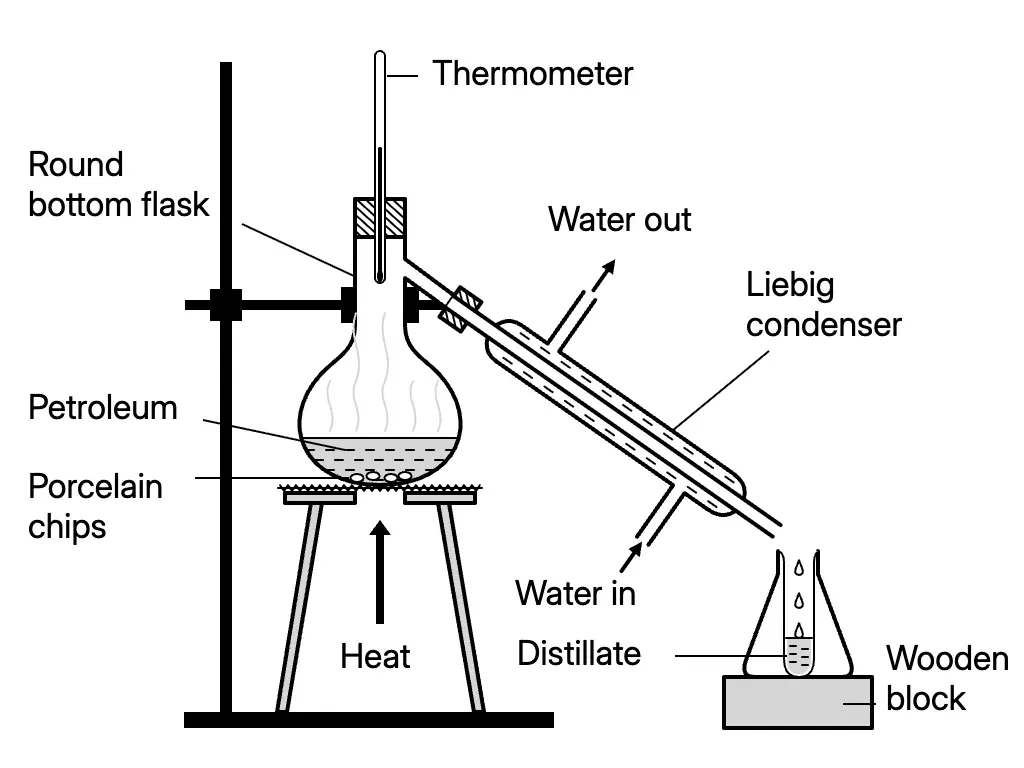
Procedure
- Place of petroleum and one spatula of porcelain chips in a round-bottom flask; assemble the fractional-distillation apparatus.
- Heat gently and collect four fractions separately at , , and .
- Record the colour and viscosity of each fraction.
- Put a few drops of a fraction on cotton in an evaporating dish, ignite it, and hold filter paper above the flame to compare flame colour and soot.
- Repeat for all four fractions and tabulate boiling range, colour, viscosity and sootiness.
Precaution: Petroleum vapour is flammable.
Renewable Alternatives to Petroleum
- Petroleum is a non-renewable fossil fuel. Most reserves were predicted to be depleted within about 100 years at the rate of use prevailing when the estimate was made.
- Biomass is organic plant and animal matter that stores energy originally obtained from sunlight.
- Renewable alternative energy sources produced from biomass through chemical processes include bioethanol, biodiesel and biogas.
Answer practice questions to test your knowledge
Practice