8.4 - Composite Materials and Its Importance
Meaning and Structure of Composite Materials
- A composite material combines two or more non-homogeneous substances: a matrix substance and a strengthening substance.
- The matrix surrounds and binds the strengthening substance.
- The components have different physical or chemical properties. Their combination produces a composite with properties better than those of the original components.
- Wood is a natural composite: lignin forms the matrix around strengthening cellulose fibres.
- Teeth are a composite of hydroxyapatite and collagen.
Examples and Uses
| Composite and components | Uses and important features |
|---|---|
| Reinforced concrete: concrete matrix with steel bars or wire mesh | Bridges, dams and buildings |
| Fibre glass: plastic matrix strengthened by glass fibres | Helmets, car bumpers and printed circuit boards |
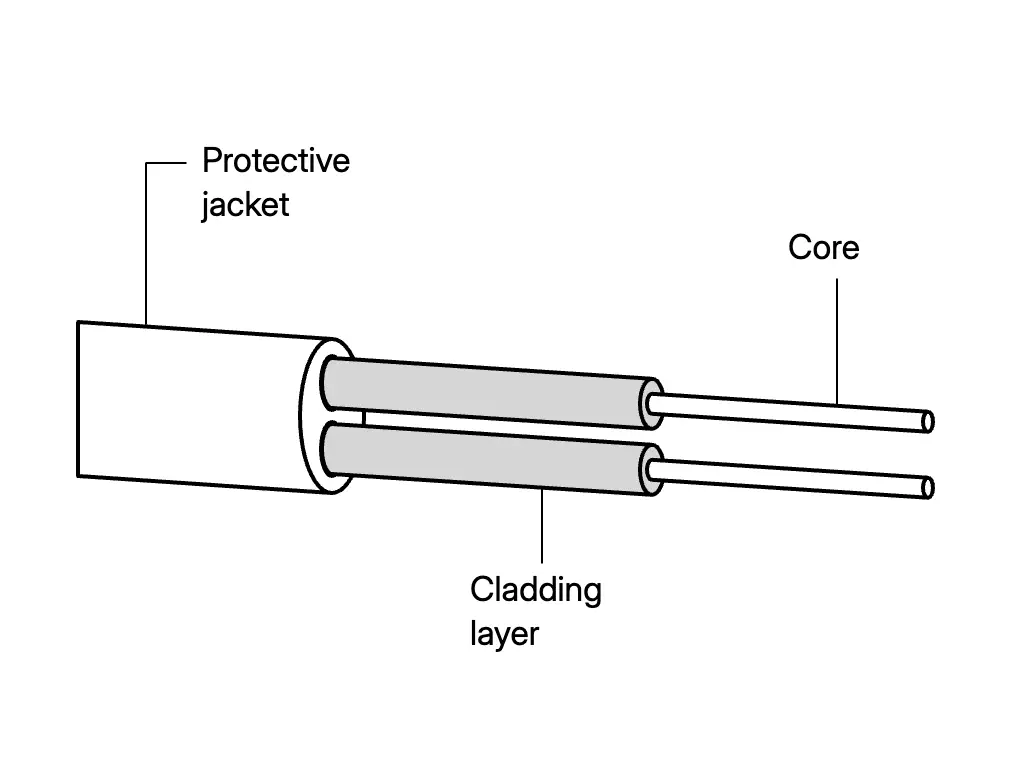
| Optical fibre: silica-glass-fibre core (strengthening substance), glass or plastic cladding (matrix), and plastic protective jacket (matrix) | Transmits information and data as light by a series of total internal reflections; used in video cameras and Local Area Networks (LANs) |
| Photochromic glass: glass matrix with silver chloride, , and copper(I) chloride, , as strengthening substances | Car windows, building windows and camera lenses; protects users from ultraviolet (UV) radiation |
| YBCO ceramic superconductor | Superconducting magnets for particle accelerators, Nuclear Magnetic Resonance (NMR) machines and Magnetic Resonance Imaging (MRI) machines |
Optical fibre
- The core and cladding have different refractive indices, enabling high-capacity data transmission that is not affected by electromagnetic interference.
Photochromic glass
- Sunlight causes silver atoms, , to form and block light, so the glass darkens.
- In dim light, catalyses the reverse process and the glass becomes transparent again.
Superconductor
- Yttrium barium copper oxide (YBCO) is a ceramic composite with superconducting properties.
- Its original components are yttrium(III) carbonate, copper(II) carbonate, barium carbonate and oxygen.
- Its magnets are light and produce very strong magnetic forces.
Comparison with Original Components
| Composite | Comparison with its components |
|---|---|
| Reinforced concrete | Concrete has high compressive strength, low tensile strength and resists corrosion. Steel reinforcement has high tensile strength but corrodes easily. Their composite has high compressive and tensile strengths and resists corrosion. |
| Fibre glass | Plastic is weak, soft and easily burned; it has low tensile strength and low heat/electrical conductivity, resists corrosion and is durable. Glass fibre has high tensile strength and low heat/electrical conductivity. The composite has high tensile strength, insulates heat and electricity, resists corrosion and is durable. |
| Optical fibre | Plastic is flexible and has high compressive strength; glass fibre is hard and brittle but has low compressive strength. The composite is both flexible and strong under compression. |
| Photochromic glass | Glass is transparent, does not absorb UV radiation and is not light-sensitive. transmits visible light, absorbs UV radiation and is light-sensitive. The composite remains transparent, absorbs UV radiation and changes its UV absorption according to light intensity. |
| YBCO superconductor | The original components have high electrical resistance at room temperature; the composite has no electrical resistance at very low temperature. |
Reusing and Recycling Paper
- Recycling 1 tonne of paper each year saves 7000 gallons of water, 4200 kilowatt-hours of energy and 17 trees.
- Old newspapers can be reused to make baskets, bag handles and papier-mâché products.
Answer practice questions to test your knowledge
Practice