8.1 - Alloy and Its Importance
Meaning and Examples of Alloys
- An alloy is a mixture of two or more elements in which the main element is a metal.
- Common alloys and uses include:
- bronze for the National Monument, medals and trophies;
- pewter for souvenirs;
- duralumin for aeroplane bodies;
- stainless steel for cutlery;
- brass for keys;
- steel for car bodies.
Comparing Alloys with Pure Metals
Experiment 8.1: Comparing an alloy with a pure metal
- Aim: Investigate the comparison between the properties of alloys and pure metals.
- Problem statement: Is an alloy more resistant to corrosion and harder than a pure metal?
- Materials: Stainless steel plate, iron plate, distilled water, bronze block and copper block.
- Apparatus: 100 cm³ beaker, 100 cm³ measuring cylinder, sandpaper, steel ball bearing, 1 kg weight, retort stand with clamp, metre ruler and cellophane tape.
Part A — resistance to corrosion
Hypothesis: Stainless steel is more resistant to corrosion than iron.
Variables:
- Manipulated: type of plate.
- Responding: corrosion of the plate.
- Fixed: size of plate and volume of distilled water.
Procedure:
- Clean the stainless steel and iron plates with sandpaper. Observe and record both surfaces.
- Immerse each plate in a separate beaker containing 80 cm³ of distilled water.
- Leave both beakers for one week.
- Remove the plates, observe their surfaces and record the results.
Results recorded: Surface condition of each plate after cleaning and after one week in distilled water.
Part B — hardness
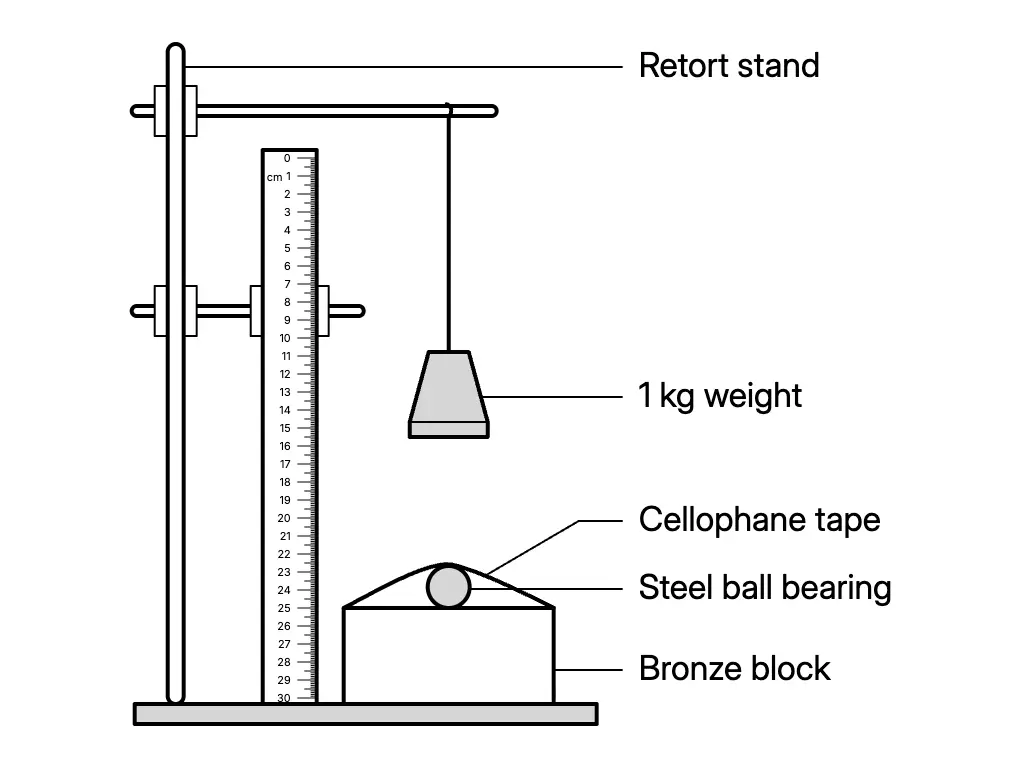
- Procedure:
- Fix a steel ball bearing to the surface of the bronze block with cellophane tape.
- Suspend a 1 kg weight 50 cm above the block.
- Release the weight onto the ball bearing.
- Measure the diameter of the dent.
- Repeat three times on different parts of the block and calculate the average diameter.
- Repeat with the copper block.
- Results recorded: Four dent diameters, in cm, and their average for each block.
Properties and Particle Arrangement
- Compared with pure metals, alloys have shiny surfaces, greater corrosion resistance and greater hardness; pure metals are dull, easily corroded and less hard.
- Alloying can prevent corrosion and alter a pure metal so that it becomes harder and stronger.
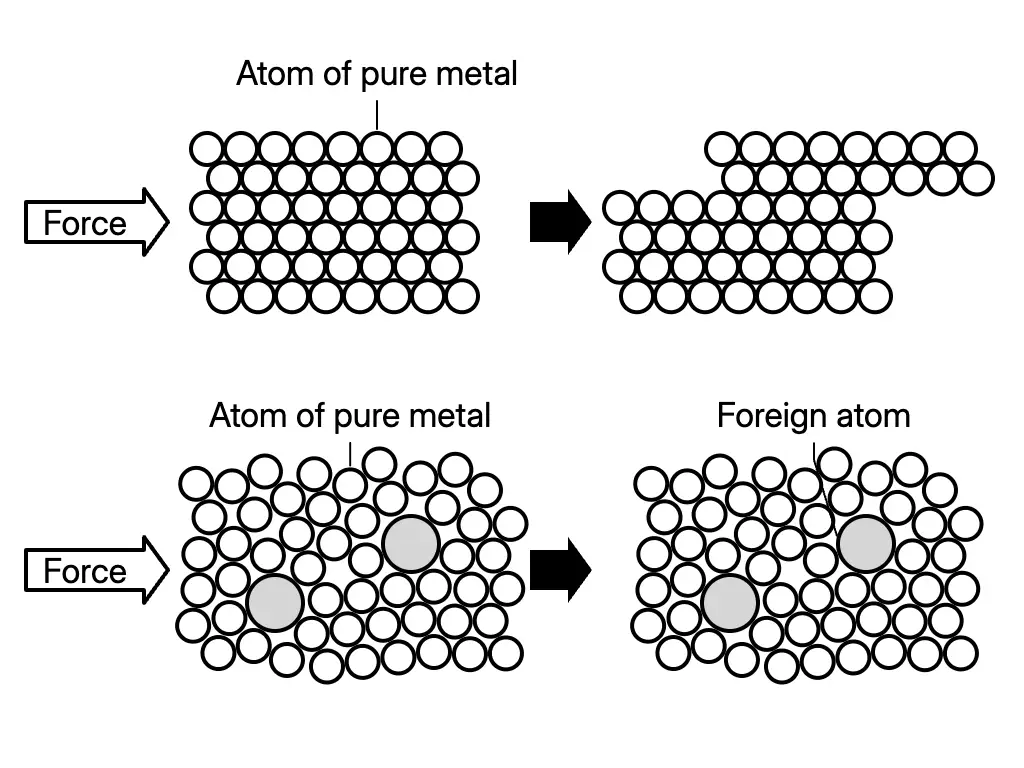
- A pure metal contains one type of atom of the same size in an orderly arrangement.
- When a force is applied, layers of atoms in a pure metal slide easily over one another. Consequently, pure metals are:
- ductile — they can be drawn into fine wires;
- malleable — they can be shaped when atoms slide into empty spaces and form a new structure.
- An alloy contains foreign atoms whose sizes differ from those of the pure metal atoms.
- These foreign atoms disrupt the orderly arrangement and make it difficult for layers of atoms to slide when force is applied. This makes the alloy harder and stronger.
Composition, Properties and Uses of Alloys
The composition percentages may vary between samples of the same alloy.
| Alloy and composition | Properties and uses |
|---|---|
| Duralumin: 93% aluminium, 3% copper, 3% magnesium, 1% manganese | Properties: Stronger than pure aluminium; low density; does not rust. Uses: Aeroplane bodies, electrical cables, racing bicycles. |
| Bronze: 90% copper, 10% tin | Properties: Stronger than pure copper; does not rust; shiny. Uses: Medals, monuments, trophies. |
| Brass: 70% copper, 30% zinc | Properties: Stronger than pure copper; does not rust; shiny. Uses: Musical instruments, doorknobs, keys. |
| Steel: 98% iron, 0.2–2% carbon | Properties: Carbon steel; stronger and harder; malleable; available as low-, medium- and high-carbon steel. Uses: Building structures, railway tracks, car bodies. |
| Stainless steel: 73% iron, 18% chromium, 8% nickel, 1% carbon | Properties: Stronger than pure iron; resistant to corrosion. Uses: Cutlery, sinks, surgical instruments. |
| Pewter: 95% tin, 3.5% antimony, 1.5% copper | Properties: Stronger than pure tin; does not rust; shiny. Uses: Decorative ornaments, trophies, souvenirs. |
- Alloys are designed for specific purposes by changing their elemental composition.
- Steel and stainless steel are both based on iron, but their different compositions give them different properties and uses.
- A superconductor is an example of an alloy used in electric transport such as the Maglev train.
- At very low temperatures, a superconductor has no electrical resistance. It can form a strong magnet that levitates and propels a Maglev train at high speed.
- Superconductivity was discovered in 1911 when Heike Kamerlingh Onnes cooled mercury to 4 K and found that it had no electrical resistance.
Answer practice questions to test your knowledge
Practice