7.4 - Collision Theory
Particle Motion and Collisions
- Matter consists of tiny, discrete particles in constant motion: particles vibrate about fixed positions in solids and move freely in liquids and gases.
- Particles collide and transfer energy. Their kinetic energies are not all equal and change continually.
- Collision theory explains how reactant particles interact to form products.
- Reactant particles must collide for a reaction to occur, but not every collision produces a reaction.
Effective Collisions
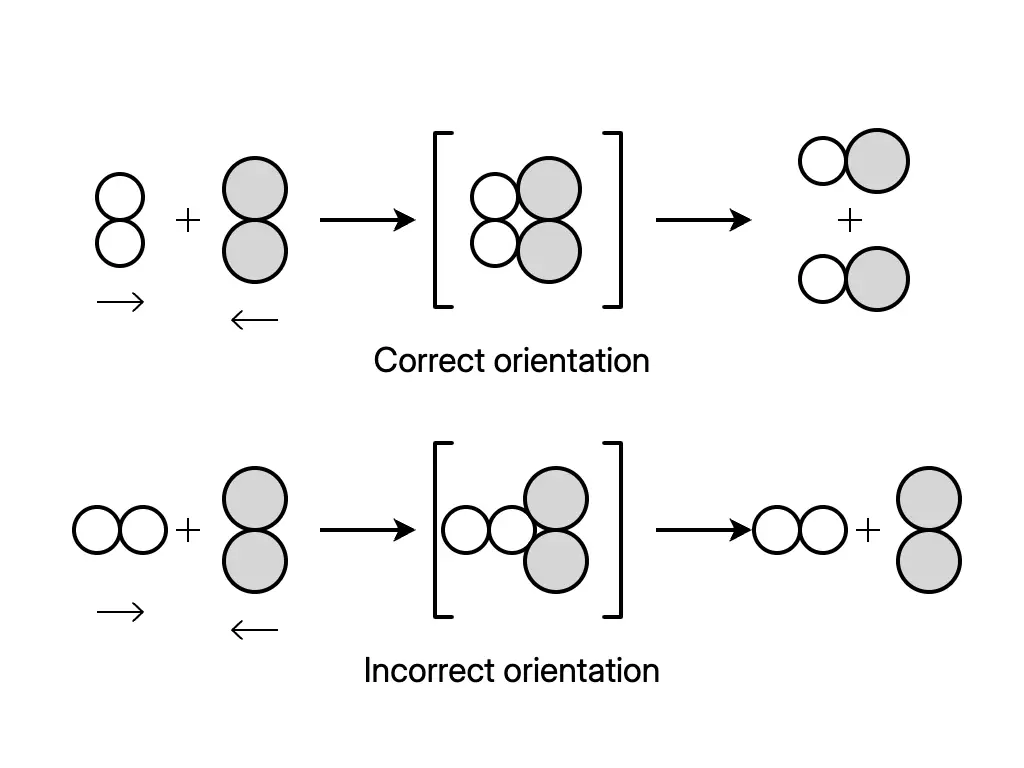
An effective collision produces a reaction. It requires both conditions:
- particles collide with energy equal to or greater than the activation energy; and
- particles collide in the correct orientation so old bonds can break and new bonds can form.
A collision with insufficient energy or incorrect orientation is ineffective; the particles separate without reacting.
Activation Energy and Energy Profiles
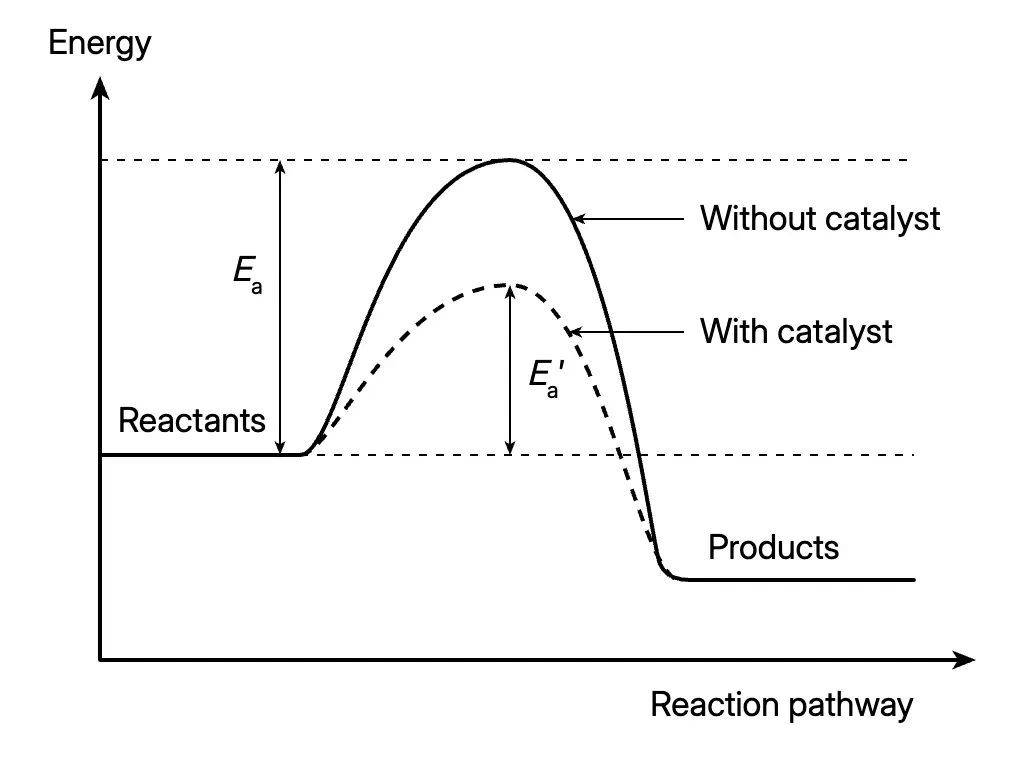
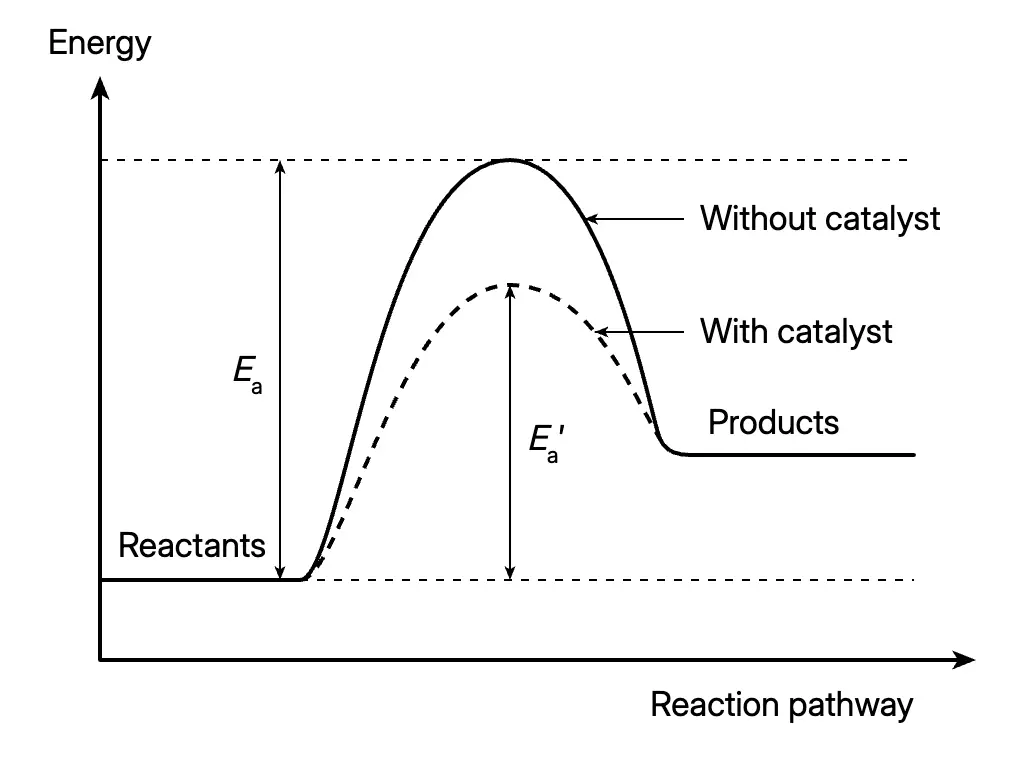
Activation energy, , is the minimum energy that reactant particles must acquire to initiate a reaction by breaking existing bonds and enabling new bonds to form.
- Energy-barrier analogy: A horse needs enough energy to clear a hurdle; similarly, reactant particles need enough energy to overcome the activation-energy barrier.
- Different reactions have different activation energies.
- Heat of reaction, , is the change in energy content when reactants become products.
- On an energy profile, is the difference between the reactant energy level and the peak of the curve.
- In an exothermic reaction, reactants have more energy than products; heat is released and is negative.
- In an endothermic reaction, products have more energy than reactants; heat is absorbed and is positive.
- Every exothermic and endothermic reaction has an activation-energy barrier.
Effect of Concentration and Pressure
When concentration increases, the number of reactant particles per unit volume increases, collision frequency rises, effective-collision frequency rises, and the rate increases. For gases, increasing pressure at constant temperature has the same particle-level effect as increasing concentration.
Effect of Reactant Size
Breaking a fixed amount of solid into smaller pieces keeps its total volume constant but increases its total exposed surface area. More particles are exposed, so collision frequency, effective-collision frequency and rate all increase.
Effect of Temperature
Increasing temperature raises the average kinetic energy of reactant particles. A larger fraction has energy equal to or greater than , so the frequency of effective collisions and the reaction rate increase.
Effect of a Catalyst
A catalyst provides an alternative reaction pathway with lower activation energy, , than the uncatalysed pathway, ; therefore, is lower than .
More reactant particles can overcome the lower barrier, so effective-collision frequency and rate increase. The catalyst remains chemically unchanged and does not change the energy levels of reactants or products; therefore, it does not change .
Answer practice questions to test your knowledge
Practice