7.1 - Determining Rate of Reaction
Fast and Slow Reactions
- Fast reactions take a short time to complete. Examples: reactions in electric cells, ignition of matches, combustion of gases and fireworks.
- Slow reactions take a long time to complete. Examples: food decay, corrosion of metals, photosynthesis, rock erosion and fermentation.
Meaning and Units of Rate of Reaction
Rate of reaction is the change in the quantity of a reactant per unit time or the change in the quantity of a product per unit time.
- The quantity of reactant decreases while the quantity of product increases as a reaction proceeds.
- Solid mass is measured in g, gas volume in or , and concentration of a soluble substance in .
- Common units are , , , , and .
- Seconds are usually suitable for fast reactions; minutes may be used for slower reactions.
Observable and Measurable Changes
| Change | Measurement or example |
|---|---|
| Formation of a precipitate | Time for a mark to disappear or mass of precipitate formed; AgCl makes a mixture cloudy when reacts with . |
| Decrease in total mass | Measure with an electronic balance when a gaseous product escapes; for example, reacting with . |
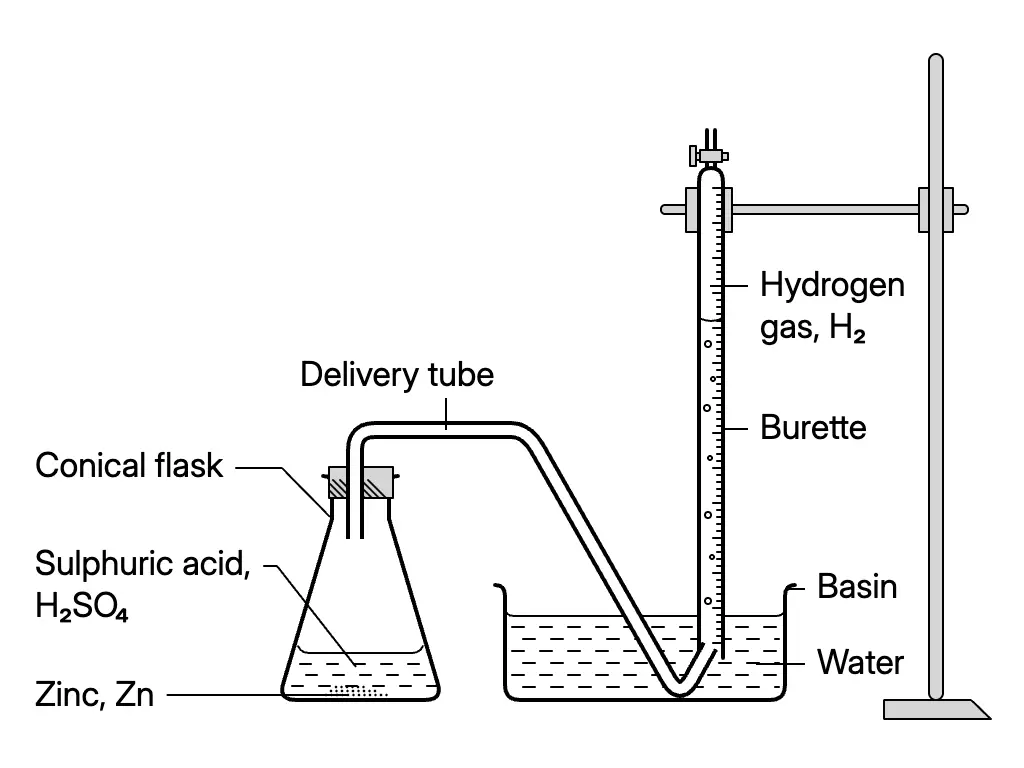
| Increase in gas volume | Collect and measure gas with a gas syringe or an inverted burette; for example, reacting with Mg to produce . |
| Change in gas pressure | Measure with a pressure gauge. |
| Change in electrical conductivity | Measure with an ammeter when freely moving ions are involved. |
| Change in pH | Measure with a pH meter when an acid or alkali is involved in aqueous solution. |
Measuring Reaction Time
- Zinc and sulphuric acid: 5.0 g zinc powder reacts with of sulphuric acid. Hydrogen is collected in a water-filled inverted burette, initially reading . Readings at 0.5-minute intervals for 5 minutes measure the increase in gas volume. All apparatus connections must be airtight. Gas volume stops increasing when the reaction ends.
- Nitric acid and marble chips: 10.0 g marble chips reacts with of nitric acid. An electronic balance records the decrease in total mass at 30-second intervals as carbon dioxide escapes. The flask is loosely plugged with cotton wool. Constant mass indicates the end of the reaction.
- Potassium iodide and lead(II) nitrate: 2.0 g of each powder is placed at opposite edges of a Petri dish containing distilled water to a depth of 0.5 cm. Reaction time ends when no more precipitate forms. The precipitate is filtered, washed with distilled water, dried and weighed to measure the quantity formed.
Average Rate of Reaction
The average rate of reaction is the average rate over a stated time interval.
For the first seconds, the average rate is , where is the gas volume collected in that interval.
Use the actual time at which the curve becomes horizontal as the completion time, not merely the final time shown on the graph.
Instantaneous Rate of Reaction
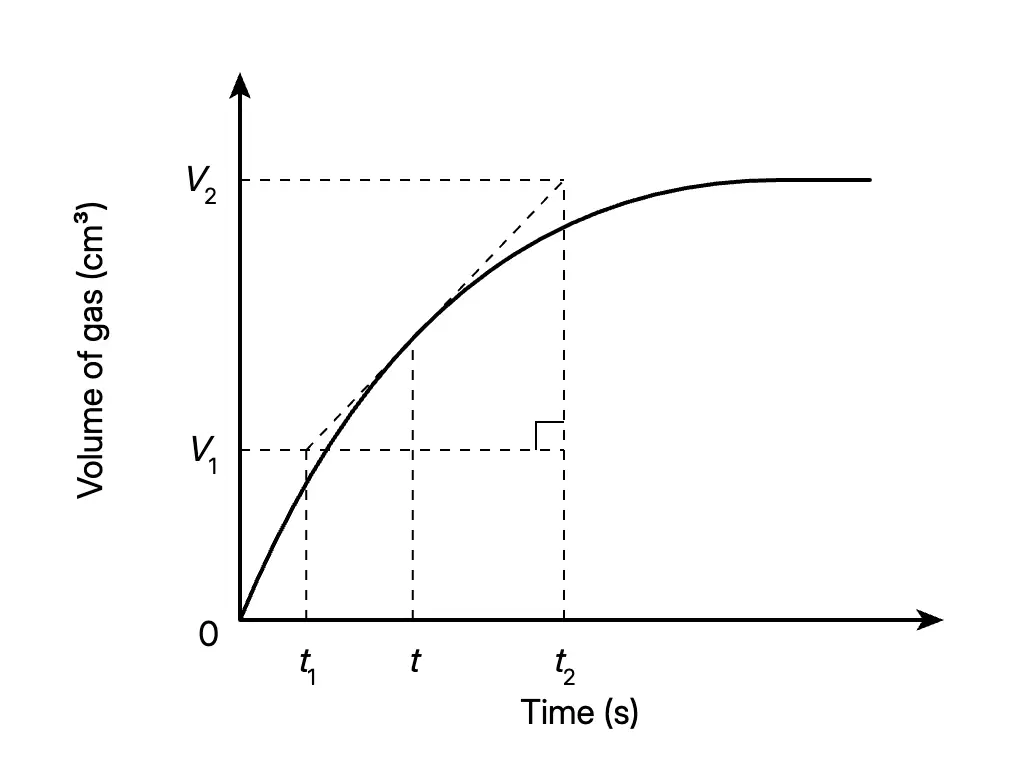
The instantaneous rate of reaction is the rate at one particular instant.
- Plot the measured quantity of reactant or product against time.
- Draw a tangent to the curve at the required time.
- Construct a large right-angled triangle using the tangent; a larger triangle gives a more accurate gradient.
- Calculate the gradient:
- A product-volume curve has a positive gradient that becomes less steep as the reaction slows.
- A total-reactant-mass curve slopes downward. Rate is stated as a positive magnitude even though its gradient is negative.
Worked Example
Magnesium carbonate in excess reacts with sulphuric acid and produces of carbon dioxide by 7 minutes.
- Fifth-minute average rate: .
- Overall average rate: .
- The tangent gradient at the second minute on the graph is .
Answer practice questions to test your knowledge
Practice