Group 17 contains fluorine, F; chlorine, Cl; bromine, Br; iodine, I; astatine, At; and tennessine, Ts.
These halogens exist as diatomic molecules.
Chlorine is used in bleach, bromine is a component in fire extinguishers and iodine is used as a disinfectant.
Physical Properties and Trends
Down the group at room temperature, physical state changes from gas to liquid to solid.
Molecular size and attraction between molecules increase, so melting and boiling points rise because more heat is needed to overcome the intermolecular forces.
Density increases with increasing mass down the group.
Halogen
State and colour
Melting / boiling point (∘C)
Chlorine, Cl2
Greenish-yellow gas
−101/−34
Bromine, Br2
Reddish-brown liquid
−7/59
Iodine, I2
Purplish-black solid
114/184
Halogen
Density (gcm−3)
Chlorine
0.00300
Bromine
3.11900
Iodine
4.95000
Chemical Properties
Each atom has seven valence electrons, accepts one electron during a reaction and forms a −1 ion:
X+e−→X−
Chlorine, bromine and iodine have similar chemical properties but different reactivities.
With water, halogens form acidic solutions. Chlorine produces hydrochloric acid and hypochlorous acid:
Cl2(g)+H2O(l)⇌HCl(aq)+HOCl(aq)
With metals, halogens form metal halides; bromine and iron produce iron(III) bromide:
2Fe(s)+3Br2(l)→2FeBr3(s)
With alkalis, halogens form a metal halide, metal halate and water; iodine and sodium hydroxide produce sodium iodide and sodium iodate(I):
I2(s)+2NaOH(aq)→NaI(aq)+NaOI(aq)+H2O(l)
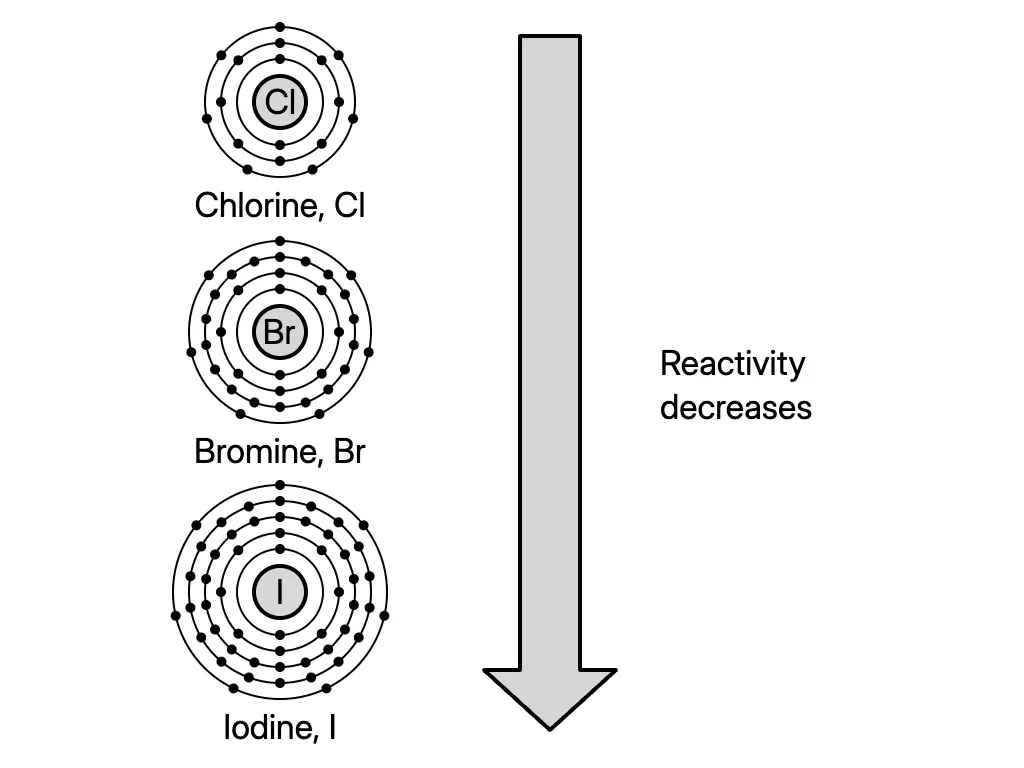
Reactivity Trend
Reactivity decreases down Group 17.
More occupied shells increase atomic size and place the valence shell farther from the nucleus.
Weaker nuclear attraction makes it more difficult for an atom to attract an electron to complete its valence shell.
Reactivity of elements decreases when going down Group 17
Other Halogens and Safety
Halogens dissolve in organic solvents and do not conduct heat or electricity.
Fluorine is a poisonous, light-yellow gas. It is very reactive and corrosive and explodes strongly when combined with hydrogen.
Astatine is rare, radioactive and chemically unstable.
Handle halogens carefully because they are dangerous.