4.4 - Elements in Group 1
Members and Uses
- Group 1 contains lithium, Li; sodium, Na; potassium, K; rubidium, Rb; caesium, Cs; and francium, Fr. They are called alkali metals.
- Lithium is used in batteries, sodium in sodium-vapour lamps and potassium compounds in fertilisers.
Physical Properties and Trends
- Group 1 elements are soft, low-density metals with grey, shiny surfaces at room temperature; they float on water.
- Their melting and boiling points are low compared with many other metals.
- Down the group, atomic radius increases while melting and boiling points decrease.
- Increasing atomic size weakens attraction between metal atoms, so less heat is needed to overcome it.
| Element | Atomic radius (nm) | Melting / boiling point () |
|---|---|---|
| Li | 0.133 | |
| Na | 0.186 | |
| K | 0.203 |
Chemical Properties
- Each atom has one valence electron, donates it during a reaction and forms a ion:
- With water, an alkaline metal hydroxide solution and hydrogen gas form:
- In oxygen, a white metal oxide forms; the oxide produces an alkaline solution in water:
- In chlorine, a white metal chloride forms:
Experiment 4.1: Reactions with Water, Oxygen and Chlorine
Aim: Study the chemical properties of Group 1 elements.
Problem statement: What are the chemical properties of Group 1 elements when they react with water, oxygen and chlorine?
Materials: Lithium, sodium, potassium, distilled water, filter paper, red litmus paper, oxygen gas and chlorine gas.
Apparatus: Forceps, white tile, basin, knife, combustion spoon, lidded gas jars, measuring cylinder and Bunsen burner.
Water reaction — teacher demonstration
- Hypothesis: Reactivity with water increases down Group 1.
- Manipulated variable: type of alkali metal; responding variable: reactivity with water; fixed variable: metal size.
- Cut a small piece of lithium with a knife and forceps; dry it on filter paper.
- Place it slowly into a basin of water.
- After the reaction, test the solution with red litmus paper and record observations.
- Repeat with sodium and potassium.
Oxygen reaction
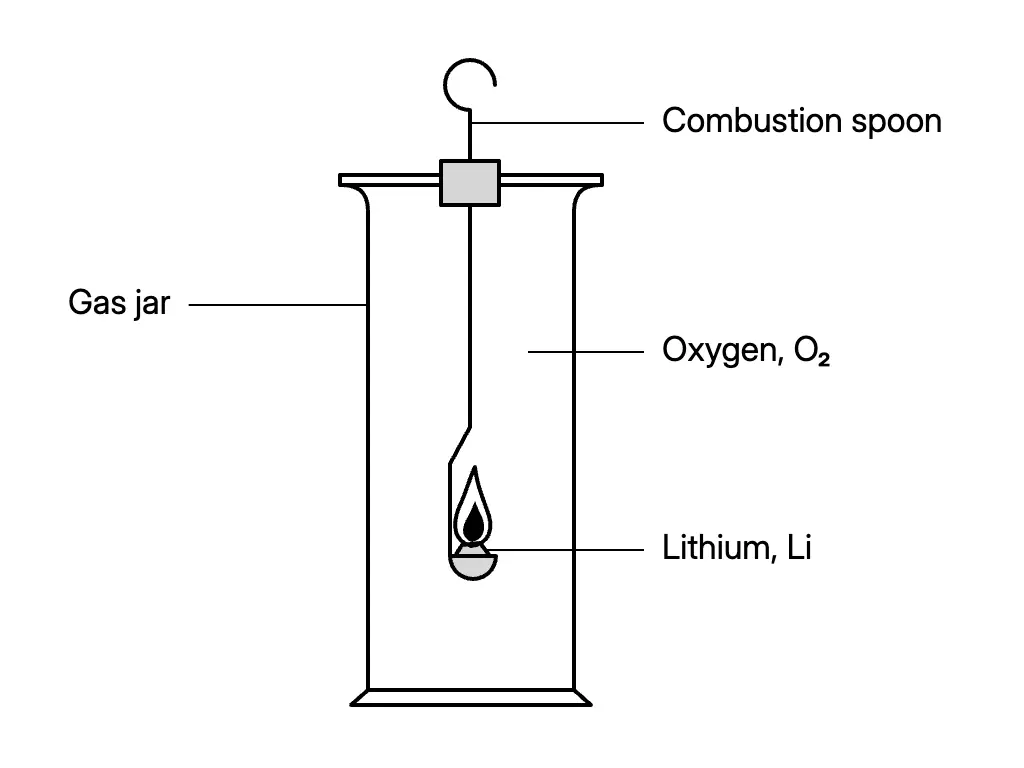
- Cut and dry a small piece of lithium, place it on a combustion spoon and heat until it burns.
- Insert it immediately into a gas jar of oxygen.
- After the reaction, add water, shake and test with red litmus paper.
- Record observations and repeat with sodium and potassium.
Chlorine reaction
- Cut and dry a small piece of lithium, place it on a combustion spoon and heat until it burns.
- Insert it immediately into a gas jar of chlorine and record observations.
- Repeat with sodium and potassium.
Safety: Use only small quantities and take care when placing alkali metals in water.
Conclusion: Lithium, sodium and potassium have similar chemical properties, but their reactivity increases in the order < < .
Reactivity Trend and Other Group 1 Elements
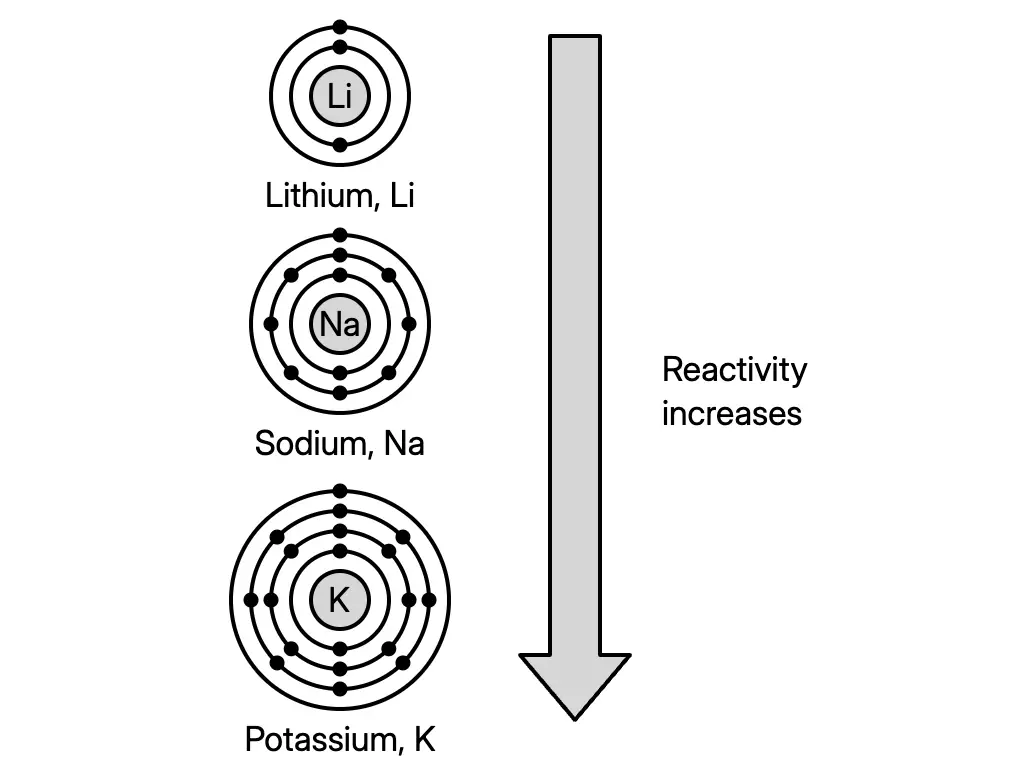
- Reactivity increases down Group 1 because more occupied shells increase atomic size.
- The valence electron is farther from the nucleus and experiences weaker nuclear attraction, so it is donated more easily.
- Rubidium, caesium and francium are soft, shiny metals with low melting and boiling points. They are very reactive with water and oxygen.
- Rubidium and caesium burn readily and usually occur combined with other elements, making chemical isolation difficult.
- Francium is an unstable radioactive isotope with a short half-life.
Answer practice questions to test your knowledge
Practice