2.3 - Atomic Structure
Proton Number and Nucleon Number
- Proton number, : number of protons in the nucleus of an atom.
- Nucleon number, : total number of protons and neutrons in the nucleus.
Therefore:
- Atoms of different elements have different proton numbers.
- A neutral atom has equal numbers of protons and electrons.
- During ion formation, the numbers of protons and neutrons in the nucleus remain unchanged; only the number of electrons changes.
- Gaining electrons forms a negatively charged anion.
- Losing electrons forms a positively charged cation.
Examples
- Aluminium with 13 protons and 14 neutrons: and .
- Potassium with and 19 protons: electrons and neutrons .
- A chlorine atom has 17 protons, 18 neutrons and 17 electrons. After accepting one electron, still has 17 protons and 18 neutrons but has 18 electrons.
Standard Representation of an Atom
The standard representation is:
- = element symbol
- = nucleon number
- = proton number
For , the element is carbon, the nucleon number is 12 and the proton number is 6. An atom with 11 protons and 12 neutrons has and is represented by .
Atomic Structure and Electron Arrangement
- Electrons orbit the nucleus in shells.
- Electrons fill the shell closest to the nucleus first, followed by the next shell after the inner shell is full.
- For elements with proton numbers 1–20, the first three shells hold a maximum of 2, 8 and 8 electrons, respectively.
- The third shell can hold up to 18 electrons for elements with proton numbers above 20.
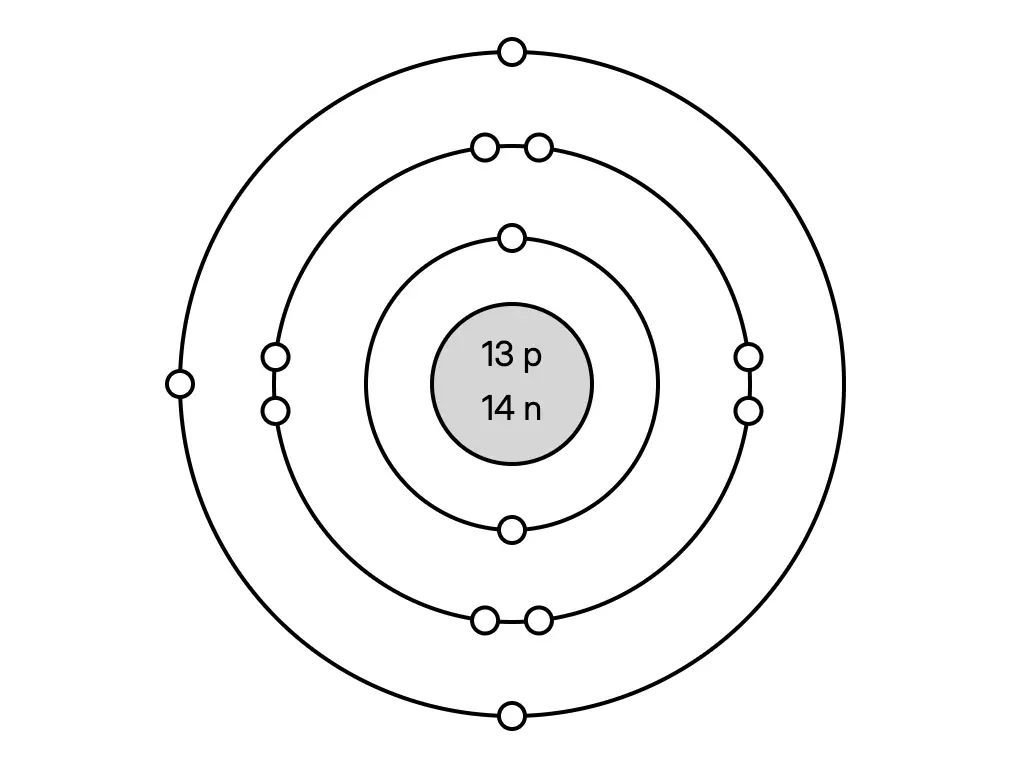
Example: aluminium
- Proton number , so a neutral aluminium atom has 13 electrons.
- Electron arrangement .
- The outermost occupied shell is the valence shell; its electrons are valence electrons.
- Aluminium has 3 valence electrons.
The chemical properties of an element depend on its number of valence electrons. Elements with the same number of valence electrons have similar chemical properties.
- An electron-arrangement diagram shows the nucleus and the distribution of electrons in shells.
- An atomic-structure diagram additionally shows the numbers of protons and neutrons in the nucleus. For , the nucleus contains 13 protons and 14 neutrons, with electron arrangement .
Answer practice questions to test your knowledge
Practice