2.1 - Basic Concepts of Matter
Matter and Its States
- Matter is anything that has mass and occupies space.
- Matter consists of tiny, discrete particles. A rainbow has neither mass nor volume, so it is not matter.
- Matter commonly exists as solid, liquid or gas. Plasma is an ionised gas and is described as the fourth state of matter. It is rare naturally on Earth but is the most common state of matter in the universe; most stars exist as plasma.
- Heating or cooling changes the state of matter by changing the particles’ kinetic energy, arrangement and attraction forces.
Particle model of the three states
- Solid: particles are closely packed in an orderly arrangement; kinetic energy is low; attraction forces are strong.
- Liquid: particles are closely packed but not orderly; kinetic energy is higher than in a solid; attraction forces are strong but weaker than in a solid.
- Gas: particles are far apart; kinetic energy is very high; attraction forces are weak.
Changes of state
- Heat is absorbed during melting (solid to liquid), boiling or evaporation (liquid to gas), and sublimation (solid to gas).
- Heat is released during freezing (liquid to solid), condensation (gas to liquid), and deposition (gas to solid).
- Example: ice cream absorbs heat at room temperature and melts. Water vapour loses heat on a cold window and condenses into droplets.
Classification of Matter by Particle Type
- Matter exists as elements or compounds.
- An element consists of atoms or molecules:
- carbon, C, consists of atoms;
- oxygen, , consists of molecules.
- A compound consists of molecules or ions:
- water, , consists of molecules;
- sodium chloride, , consists of ions.
- Ions form through the transfer of electrons between atoms. A sodium atom donates one electron to form , while a chlorine atom accepts one electron to form .
Melting Point and Freezing Point
- Melting point: the constant temperature at which a substance changes from solid to liquid at a specific pressure.
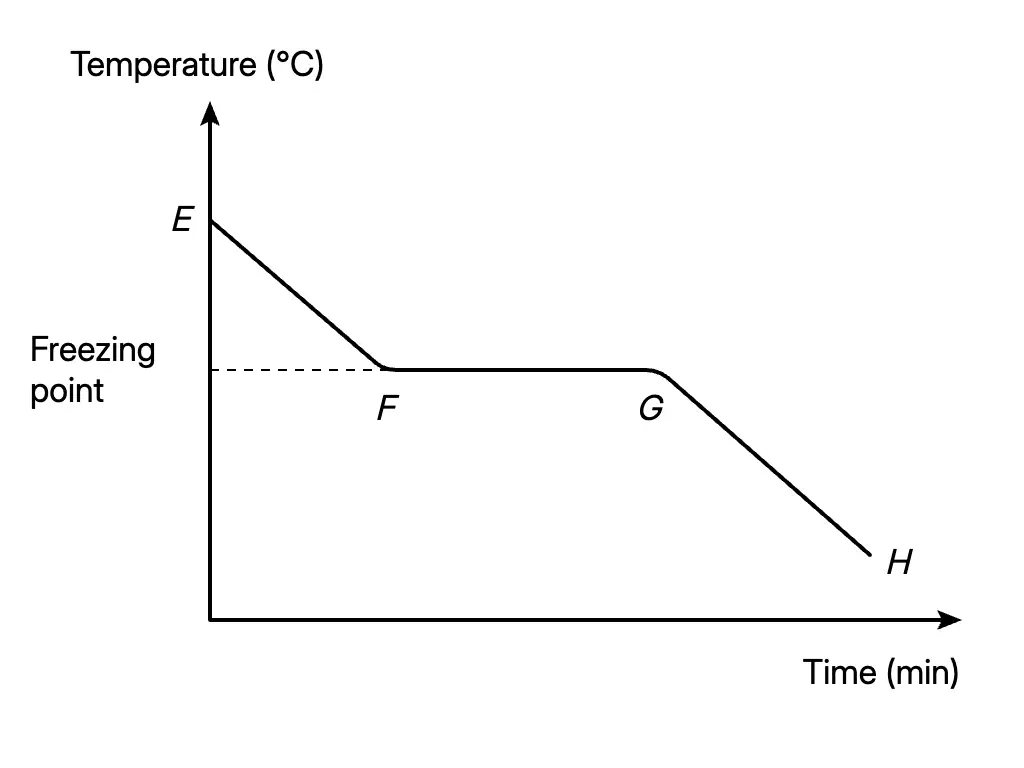
- Freezing point: the constant temperature at which a substance changes from liquid to solid at a specific pressure.
Determining the Melting and Freezing Points of Naphthalene
Aim: Determine the melting point and freezing point of naphthalene, .
Materials: Naphthalene, , and water.
Apparatus: Boiling tube, beaker, thermometer, tripod stand, retort stand and clamp, Bunsen burner, stopwatch, conical flask, wire gauze and spatula.
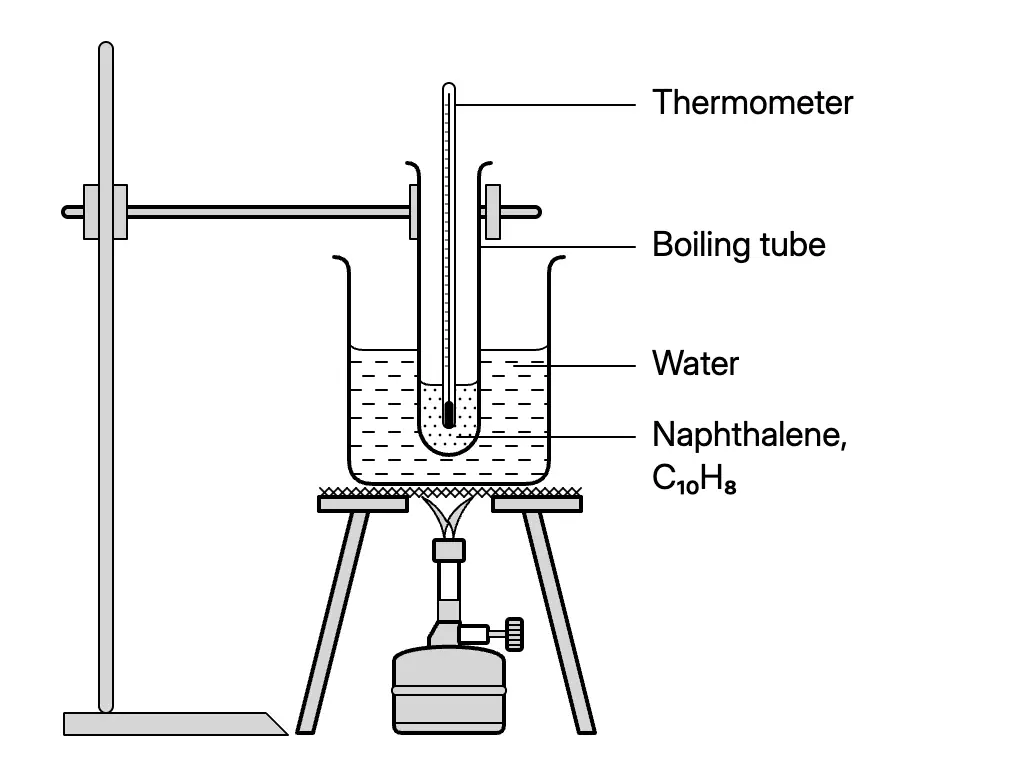
Procedure
- Fill one third of a boiling tube with naphthalene and place a thermometer in it.
- Half-fill a beaker with water. Immerse and clamp the boiling tube so that the naphthalene level is below the water level.
- Heat the water and stir the naphthalene slowly with the thermometer.
- At , start the stopwatch. Record the temperature and state every 30 seconds until .
- Remove the boiling tube from the water bath, dry its outer surface, and place it in a conical flask.
- Stir continuously. Record the temperature and state every 30 seconds until the temperature falls to .
Data interpretation: Temperature-against-time graphs show solid, liquid and mixed-state regions. The constant-temperature regions identify the melting and freezing points.
Safety: Avoid touching naphthalene or inhaling its vapour. Glucose-6-phosphate dehydrogenase (G6PD) deficiency is a genetic disease. Exposure can cause haemolysis (destruction of red blood cells) in a person with G6PD deficiency, causing tiredness and dizziness.
Interpreting Heating and Cooling Curves
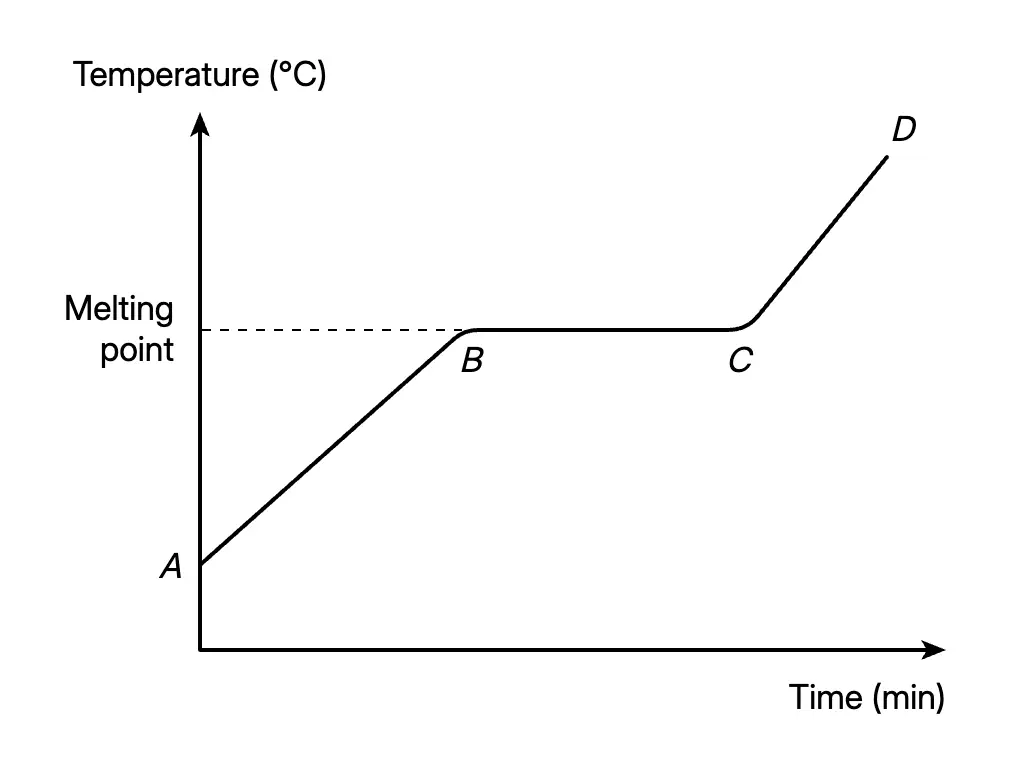
Heating, solid region (A–B): particles absorb heat, gain kinetic energy and vibrate faster; temperature rises.
Melting plateau (B–C): solid and liquid coexist. Temperature stays constant because absorbed heat overcomes attraction forces between particles rather than increasing kinetic energy.
Heating, liquid region (C–D): liquid particles absorb heat and move faster; temperature rises.
Cooling, liquid region (E–F): particles release heat, lose kinetic energy and move more slowly; temperature falls.
Freezing plateau (F–G): liquid and solid coexist. Temperature stays constant because heat lost to the surroundings is balanced by heat released as particles attract one another to form a solid.
Cooling, solid region (G–H): solid particles release heat and vibrate more slowly; temperature falls.
Lauric acid, , is a fatty acid obtained from coconuts and can replace naphthalene in this determination.
Answer practice questions to test your knowledge
Practice