5.2 - Enzymes
Definition and Necessity of Enzymes
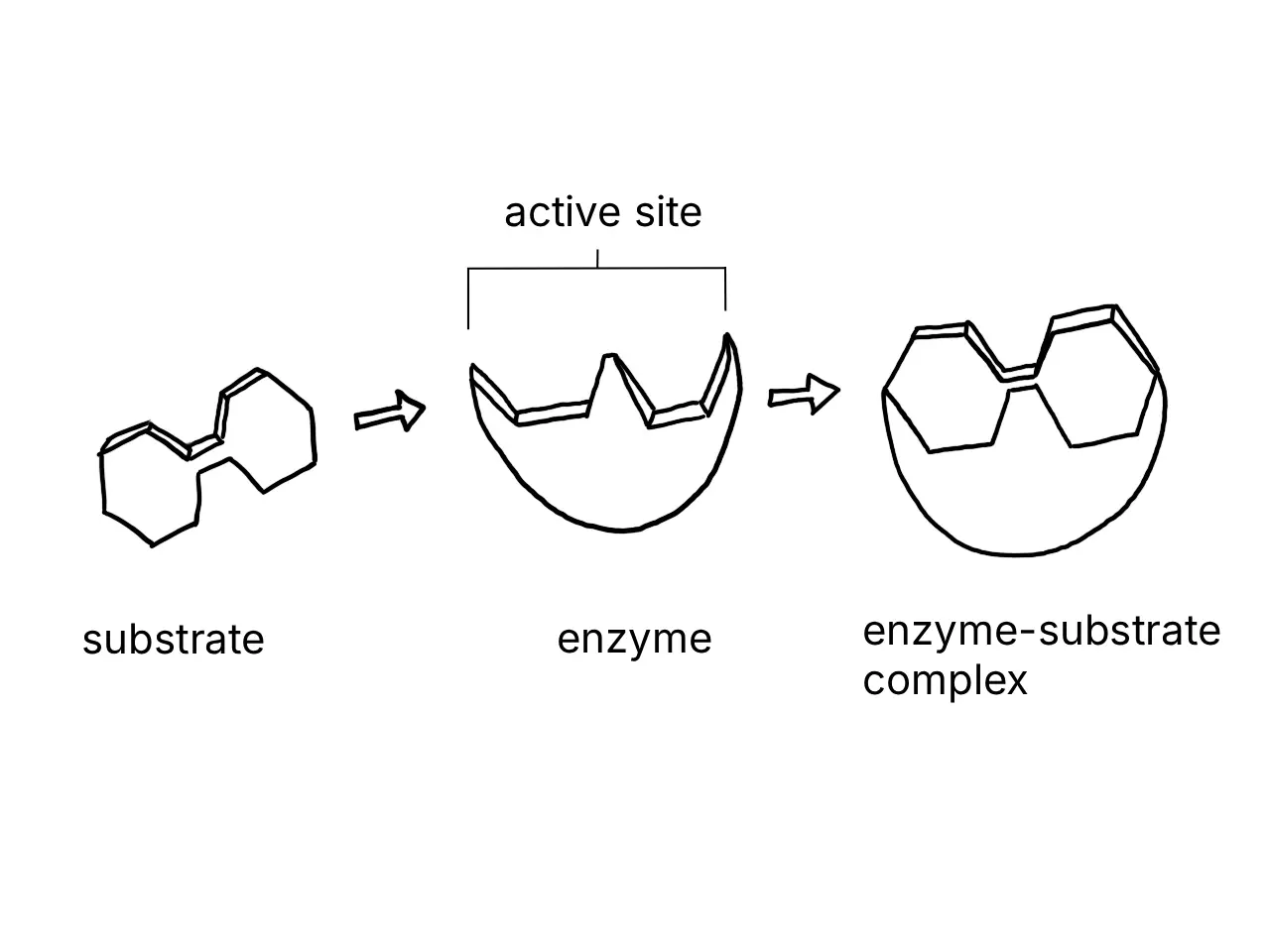
- Biochemical reactions must occur rapidly in cells to maintain living processes.
- Enzymes accelerate these biochemical reactions.
- Enzyme: An organic catalyst, mostly made up of proteins, produced by cells of living organisms.
- Not all enzymes are synthesised from proteins.
- Substrate: A substance required for an enzyme reaction.
- A substrate binds to an enzyme at a specific active site to form an enzyme-substrate complex.
Enzyme Nomenclature
- In the 1960s, the International Union of Biochemistry and Molecular Biology (IUBMB) introduced enzyme nomenclature based on the substrate or reaction catalysed.
- The enzyme name is derived by adding -ase to the name of its substrate.
- Example: Lactase catalyses the hydrolysis of lactose.
- Enzymes discovered before systematic nomenclature may retain conventional names, such as trypsin, pepsin and renin.
General Characteristics of Enzymes
- Biological catalysts that accelerate biochemical reactions.
- Act rapidly.
- Required in small quantities and reusable.
- Remain unchanged and are not destroyed after a reaction.
- Most enzyme-catalysed reactions are reversible.
- Specific: Only a substrate with a complementary shape can bind to the active site.
- Some require cofactors, such as vitamin B and magnesium ions, to work more efficiently.
- Inhibitors can slow or stop enzyme activity; examples include lead and mercury.
Intracellular and Extracellular Enzymes
- Intracellular enzymes: Synthesised in a cell for its own use.
- Example: Hexokinase is used in glycolysis during cellular respiration.
- Extracellular enzymes: Secreted outside the cell.
- Example: Trypsin is produced by pancreatic cells and secreted into the duodenum to break down polypeptides.
Production of Extracellular Enzymes
- Ribosome is the site of protein synthesis.
- Proteins synthesised by ribosomes enter the lumen of the rough endoplasmic reticulum and are transported through it.
- At the end of the rough endoplasmic reticulum, the membrane buds off to form transport vesicles.
- Transport vesicles containing proteins move to and fuse with the Golgi apparatus.
- The Golgi apparatus modifies the proteins into enzymes and packages them in secretory vesicles formed from its tip.
- Secretory vesicles move to and fuse with the plasma membrane to secrete extracellular enzymes.
Mechanism of Enzyme Action
The ‘Lock and Key’ Hypothesis
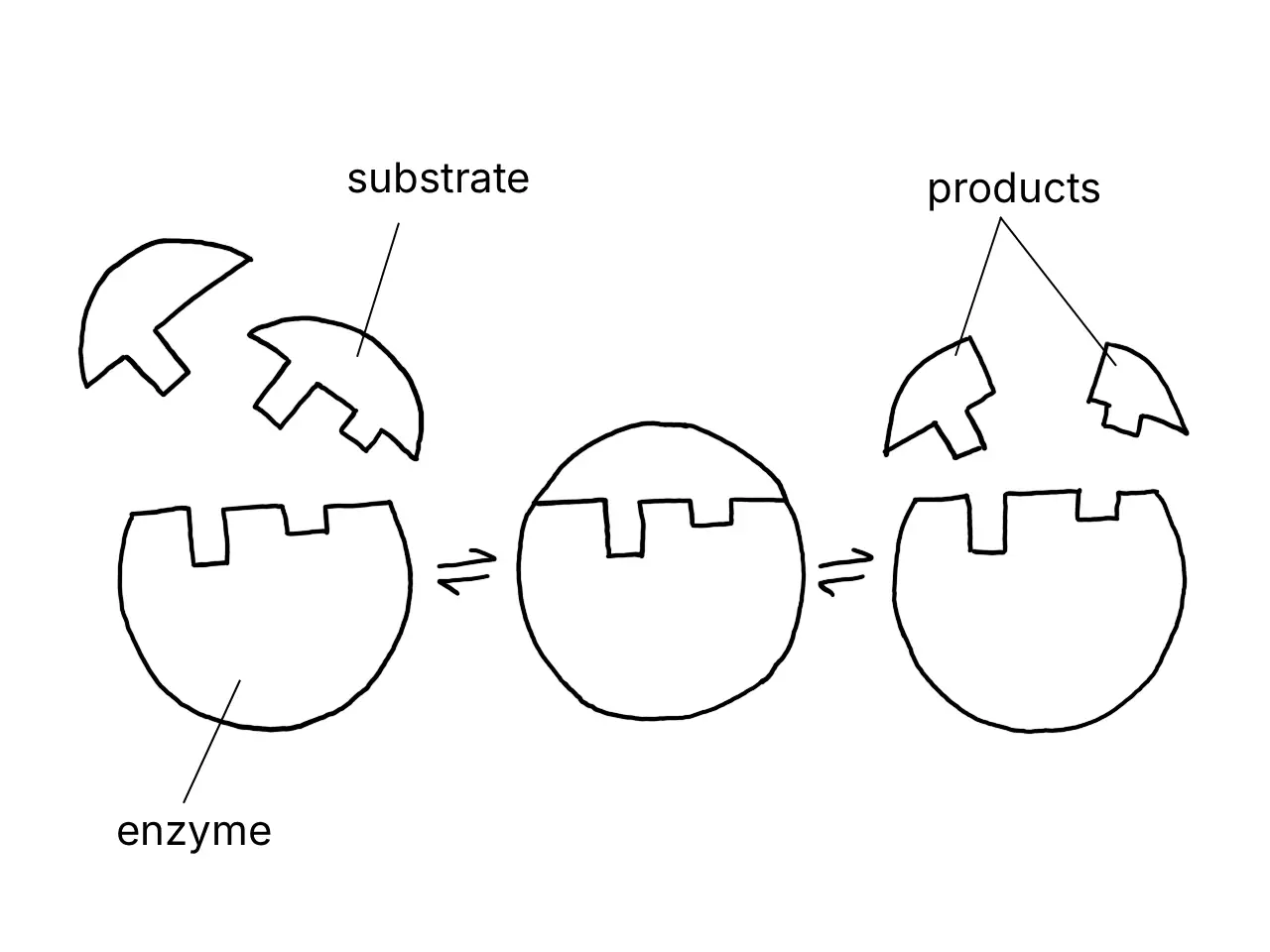
- Most enzymes are complex proteins with polypeptide chains folded into three-dimensional structures.
- The active site has a specific configuration complementary to a specific substrate.
- The enzyme represents the lock; the substrate represents the key.
- Sequence:
- The specific substrate approaches the enzyme.
- The substrate binds to the active site, forming an enzyme-substrate complex.
- A reaction occurs; products form and leave the active site.
Activation Energy
- Activation energy: Energy needed to break bonds in substrate molecules before a reaction can occur.
- Most reactions in cells require high activation energy.
- Enzymes lower activation energy and accelerate biochemical reactions in cells.
Factors Affecting the Mechanism of Enzyme Action
- Temperature, pH, substrate concentration and enzyme concentration affect enzyme action.
Effect of Temperature
- Low temperature:
- Enzyme-catalysed reaction rate is low.
- Temperature increases:
- Kinetic energy of enzyme and substrate molecules increases.
- Effective collision frequency increases.
- Reaction rate increases and doubles for every rise until the optimum temperature.
- Optimum temperature:
- Reaction rate is maximum.
- Optimum temperature for enzymes in the human body is about .
- Above the optimum temperature:
- Activity decreases rapidly and stops at .
- High temperature breaks chemical bonds in the enzyme; the enzyme is denatured.
- The three-dimensional structure and active site change, so the substrate is no longer complementary to the active site.
Effect of pH
- Enzymes act most effectively at their optimum pH.
- Most enzymes are most active between pH 6 and 8.
- Salivary amylase: pH 6.8.
- Pepsin in the stomach: pH 1.5–2.5.
- Trypsin in the duodenum: About pH 8.5.
- A pH change alters the charge of the active site and substrate surface; the enzyme-substrate complex cannot form.
- If pH returns to optimum, the active-site charge is restored and the enzyme functions normally.
- An extreme pH change breaks structural chemical bonds, changes the active site and denatures the enzyme.
Effect of Substrate Concentration
- Conditions: Enzyme concentration is fixed; substrate concentration increases.
- More substrate increases effective collisions and product formation.
- Reaction rate increases until it reaches a maximum, then remains constant.
- At maximum rate:
- all active sites are saturated with substrate;
- enzyme concentration is the limiting factor;
- adding more enzyme increases the reaction rate.
Effect of Enzyme Concentration
- More enzyme provides more active sites and increases reaction rate.
- Doubling enzyme concentration doubles the substrate converted into products per unit time if substrate is in excess.
- At maximum rate:
- substrate concentration is the limiting factor;
- adding more substrate increases the reaction rate.
Experiments on Enzyme Activity
Effect of Temperature on Amylase Activity
- Problem statement: What is the effect of temperature on the reaction rate of amylase?
- Hypothesis: Reaction rate increases with temperature up to the optimum temperature, then decreases.
- Variables:
- Manipulated: Temperature.
- Responding: Reaction rate of amylase.
- Fixed: Concentrations of amylase and starch suspension; pH of the reaction medium.
- Method:
- Incubate separate 1% starch suspensions and 0.5% amylase solutions for 5 minutes in water baths at , , , and .
- Mix each temperature-matched pair and start the stopwatch immediately.
- Test samples with iodine solution at fixed intervals while keeping the mixtures in their water baths.
- Record the time when starch hydrolysis is complete: The iodine mixture remains brownish yellow.
- Calculate and plot reaction rate against temperature.
Effect of pH on Pepsin Activity
- Problem statement: What is the optimum pH for a pepsin reaction?
- Hypothesis: pH 2 is optimum for the pepsin reaction.
- Variables:
- Manipulated: pH of the reaction medium.
- Responding: Clarity or turbidity of the reaction mixture.
- Fixed: Concentrations of albumen and pepsin solutions; temperature of the reaction medium.
- Method:
- Prepare three test tubes containing 5 ml albumen suspension.
- Add 1 ml of 1% pepsin solution and, respectively, 1 ml of 0.1 M hydrochloric acid, distilled water or 0.1 M sodium hydroxide solution.
- Measure and record each mixture’s pH.
- Incubate all tubes at for 20 minutes.
- Record clarity or turbidity at 0 minutes and after 20 minutes.
Answer practice questions to test your knowledge
Practice