3.2 - Concept of Movement of Substances Across a Plasma Membrane
Characteristics of Substances That Move Across a Plasma Membrane
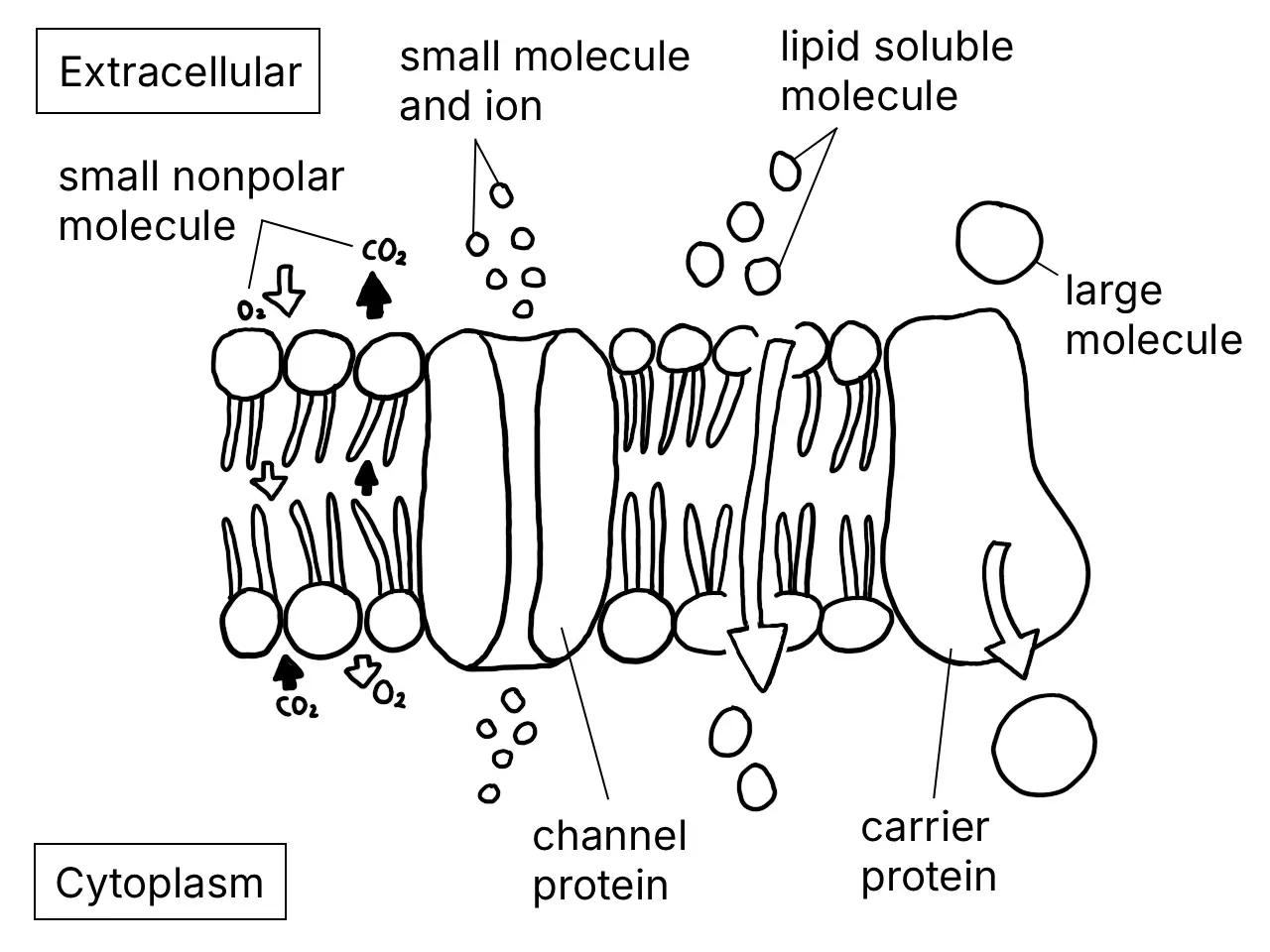
- Movement depends on molecule size, molecule polarity and ionic charge.
- Lipid-soluble, nonpolar substances move through the phospholipid bilayer: fatty acids, glycerol, fat-soluble vitamins (A, D, E and K) and steroid compounds.
- Small lipid-insoluble molecules and ions move with the aid of transport proteins:
- polar molecule: water;
- nonpolar molecules: oxygen and carbon dioxide;
- ions: , , and .
- Large lipid-insoluble molecules move with the aid of carrier proteins: glucose and amino acids.
Experiment: Molecule Size and a Selectively Permeable Membrane
- Problem: Does the size of dissolved particles affect movement across a selectively permeable membrane?
- Hypothesis: Small molecules diffuse through the membrane; large molecules do not.
- Manipulated variable: molecule size. Responding variable: presence of molecules in the Visking tubing and beaker. Fixed variables: solution temperature and immersion time.
- Fill Visking tubing with glucose solution and starch suspension; immerse it in distilled water for 30 minutes.
- Test the tubing contents and beaker solution with iodine and Benedict’s tests.
- Glucose molecules cross the Visking tubing because they are smaller than its pores; starch molecules do not because they are larger than its pores.
- Visking tubing and the plasma membrane are selectively permeable.
Experiment: Simple Osmometer
- Problem: How does time affect the level of sucrose solution in a simple osmometer?
- Hypothesis: The level of sucrose solution rises with time.
- Manipulated variable: time. Responding variable: rise in sucrose-solution level in the capillary tube. Fixed variable: sucrose-solution concentration.
- Fill Visking tubing with 30% sucrose solution, attach it to a capillary tube and immerse it in distilled water.
- Record the solution level every two minutes and plot solution level against time.
- Water moves through the selectively permeable Visking tubing into the sucrose solution by osmosis, so the level rises.
Passive Transport
- Does not require energy.
- Moves substances down the concentration gradient.
- Continues until dynamic equilibrium is achieved.
- Includes simple diffusion, osmosis and facilitated diffusion.
Simple Diffusion
- Movement of molecules or ions from high concentration to low concentration, down the concentration gradient, until dynamic equilibrium is achieved.
- May occur with or without a plasma membrane.
- Fatty acids, glycerol, oxygen and carbon dioxide diffuse through the phospholipid bilayer.
Osmosis
- Net random movement of water molecules from high water potential (low solute concentration) to low water potential (high solute concentration) through a selectively permeable membrane.
- The membrane is permeable to water but impermeable to some solutes such as sucrose.
Facilitated Diffusion
- Ions and large lipid-insoluble molecules such as amino acids and glucose move with the aid of channel or carrier proteins.
- Does not require energy; substances move down the concentration gradient until dynamic equilibrium is achieved.
- Channel proteins form specific channels or canals for small solutes and specific ions.
- Carrier proteins have specific sites that bind only to particular molecules.
- Glucose binds to the specific site of its carrier protein; the protein changes shape, moves glucose across the membrane, releases it and returns to its original shape.
Active Transport
- Moves molecules or ions against the concentration gradient.
- Requires energy from ATP generated during cellular respiration.
- Requires specific carrier proteins with specific binding sites; these carrier proteins are called pumps.
- A carrier protein binds the substance and ATP; attachment of a phosphate group changes the protein’s shape and moves the substance across the membrane.
- Active transport accumulates or removes molecules or ions in cells.
Sodium–Potassium Pump
- Three sodium ions bind to the carrier protein inside the cell.
- ATP decomposes into ADP and phosphate; the phosphate binds to the carrier protein.
- The phosphate bond supplies energy and changes the carrier protein’s shape; sodium ions move out of the cell.
- Two potassium ions bind to the carrier protein outside the cell; the phosphate leaves.
- Loss of phosphate restores the carrier protein’s original shape.
- Potassium ions move into the cell.
Proton Pump
- Proton pumps occur in epithelial cells lining the stomach cavity.
- Energy from ATP enables carrier proteins to move hydrogen ions into the extracellular fluid.
- Hydrogen ions accumulate and cause acid production in the stomach cavity.
Passive Transport and Active Transport
- Both move substances across a selectively permeable membrane.
- Passive transport: no energy required; follows the concentration gradient; continues until dynamic equilibrium.
- Active transport: requires energy; moves against the concentration gradient; accumulates or removes molecules or ions.
Answer practice questions to test your knowledge
Practice