Support and Movement in Humans and Animals
14.2 - Musculoskeletal System of Humans
Human Skeletal System Overview
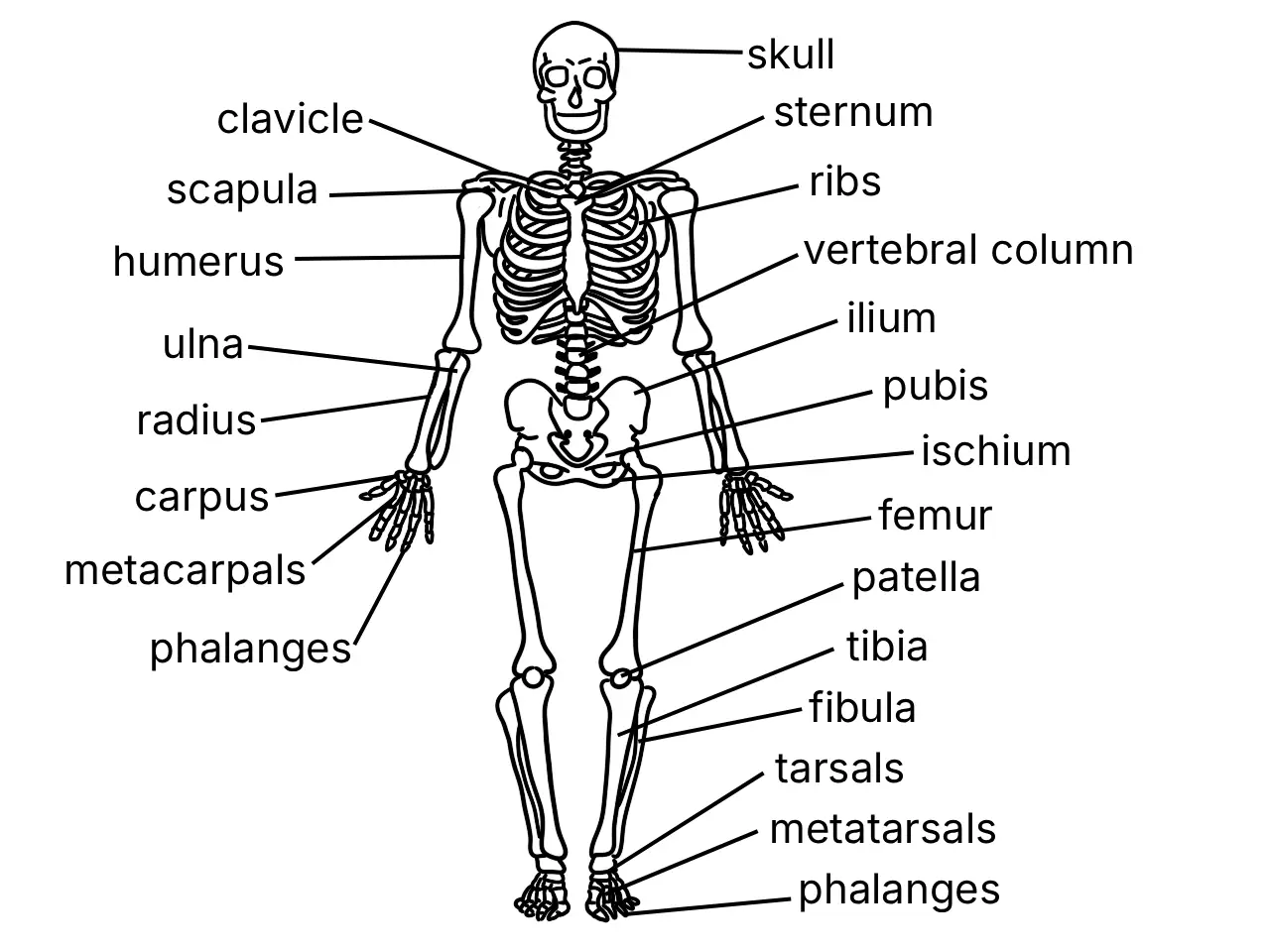
- The human skeletal system consists of the axial skeleton and appendicular skeleton.
Axial Skeleton
- Forms the main axis of the body.
- Consists of the skull, vertebral column, ribs, and sternum (breastbone).
Appendicular Skeleton
- Consists of the pectoral girdle, pelvic girdle, upper limbs, and lower limbs.
- Pectoral girdle: clavicle and scapula.
- Upper limb: humerus, radius, ulna, carpus, metacarpals, and phalanges.
- Pelvic girdle: ilium, ischium, and pubis.
- Lower limb: femur, patella, tibia, fibula, tarsals, metatarsals, and phalanges.
Human Vertebral Column
- Vertebrae on different parts of the vertebral column differ in size and shape.
- Each vertebra has a neural canal that contains the spinal cord.
Types of Vertebrae
- Thoracic vertebrae:
- Long spinous process.
- Spinous and transverse processes are attachment sites for muscles and ligaments.
- Transverse processes, except those of the 11th and 12th thoracic vertebrae, have facets for articulation with the ribs.
- Lumbar vertebrae:
- Biggest and strongest vertebrae.
- Short spinous process.
- Large centrum bears the weight of the lower back.
- Sacral vertebrae: five vertebrae fuse to form a triangular bone.
- Caudal vertebrae: four bones fuse to form a triangular structure pointed at one end.
- Atlas vertebra:
- First cervical vertebra.
- Large neural canal, small spinous process, a pair of transverse foramina, and no centrum.
- Articulates with the skull.
- Axial vertebra:
- Second cervical vertebra.
- Large spinous process, small transverse process, and a pair of transverse foramina.
- Odontoid process articulates with the facet of the atlas vertebra’s neural canal.
- Cervical vertebrae: short spinous process, small centrum, wide and short transverse process, and a pair of transverse foramina.
Comparison of Cervical, Thoracic, and Lumbar Vertebrae
| Feature | Cervical vertebrae | Thoracic vertebrae | Lumbar vertebrae |
|---|---|---|---|
| Spinous process | Short | Long | Short |
| Transverse process | Wide and short | Long | Short |
| Centrum | Small | Medium-sized | Large |
| Transverse foramina | One pair | Absent | Absent |
- Similarity: all vertebrae have spinous and transverse processes, a centrum except the atlas vertebra, and a neural canal.
Joints
- A joint is a point where two or more bones meet, or where cartilage and bone meet.
- Immovable joint: suture at the cranium of the skull.
- Slightly moveable joint: cartilage discs between vertebrae; cartilage between the first rib and sternum.
- Freely moveable joint: hinge joint and ball-and-socket joint.
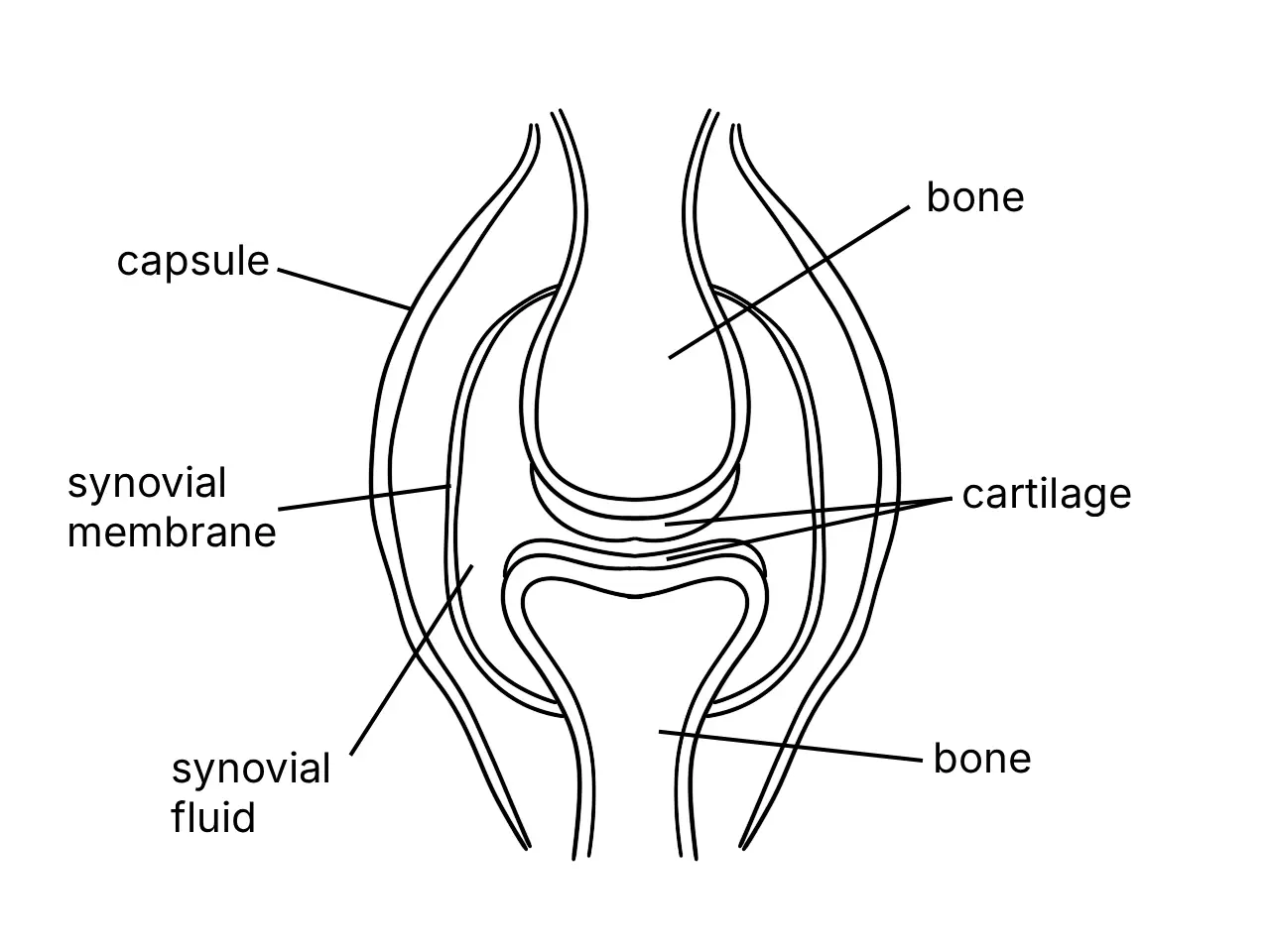
- Capsule: fibrous tissue that encloses and protects the joint.
- Cartilage: cushions the joint, absorbs shocks, reduces friction between bone ends, and protects bones from wearing out.
- Synovial membrane: secretes synovial fluid into the synovial cavity.
- Synovial fluid: lubricates the joint and reduces friction between bone ends.
Types of Freely Moveable Joints
- Ball-and-socket joint:
- Allows rotational movement in all directions.
- Examples: shoulder joint between the humerus and pectoral girdle; hip joint between the femur and pelvic girdle.
- Hinge joint:
- Allows movement in one plane.
- Examples: knee, elbow, and phalanges of the fingers and toes.
Skeletal Muscle, Tendon, and Ligament
- Skeletal muscle:
- Consists of bundles of muscle fibres with a large supply of nerves and blood vessels.
- Muscles work in antagonistic pairs: when one contracts, the other relaxes.
- An extensor straightens a limb when it contracts; the triceps is an extensor.
- A flexor bends a limb when it contracts; the biceps is a flexor.
- Tendon: connects muscle to bone; consists of strong fibres that are non-elastic but flexible.
- Ligament: connects bone to bone; consists of strong, elastic, and tough connective tissue bundles; supports and strengthens joints and allows bones to bend at joints.
Answer practice questions to test your knowledge
Practice