9.1 - Satellite
A satellite is an object which orbits a planet or star.
- The Moon is a natural satellite which orbits Earth.
- Many man-made satellites also orbit Earth.
Types of Satellite Orbits
Satellite orbits around Earth are grouped into five types according to orbital height (altitude).
| Orbit | Orbital height and orbital plane |
|---|---|
| Low Earth Orbit (LEO) | |
| Medium Earth Orbit (MEO) | |
| High Earth Orbit (HEO) | Equal to or exceeding |
| Geostationary Orbit (GEO) | ; the equatorial plane is its orbital plane |
| Geosynchronous Orbit (GSO) | ; orbital plane is inclined to the equatorial plane |
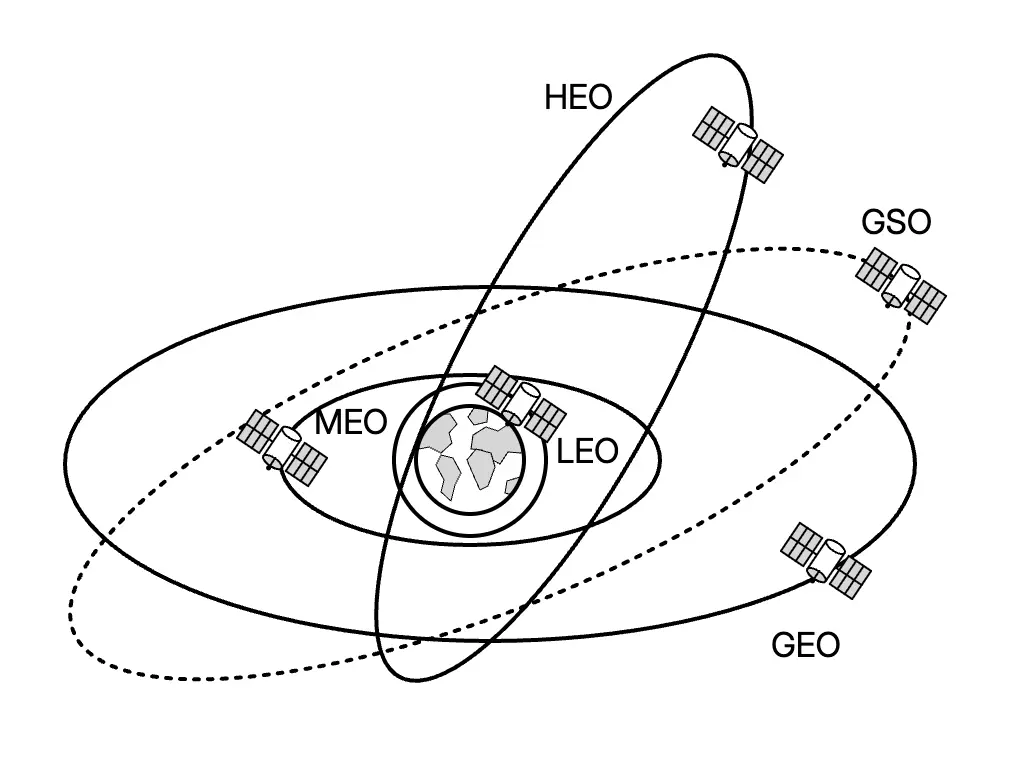
Orbital Shapes
There are two orbital shapes:
- Perfectly circular — GEO is an example.
- Elliptical — MEO and HEO are examples.
- LEO and GSO may be perfectly circular or elliptical.
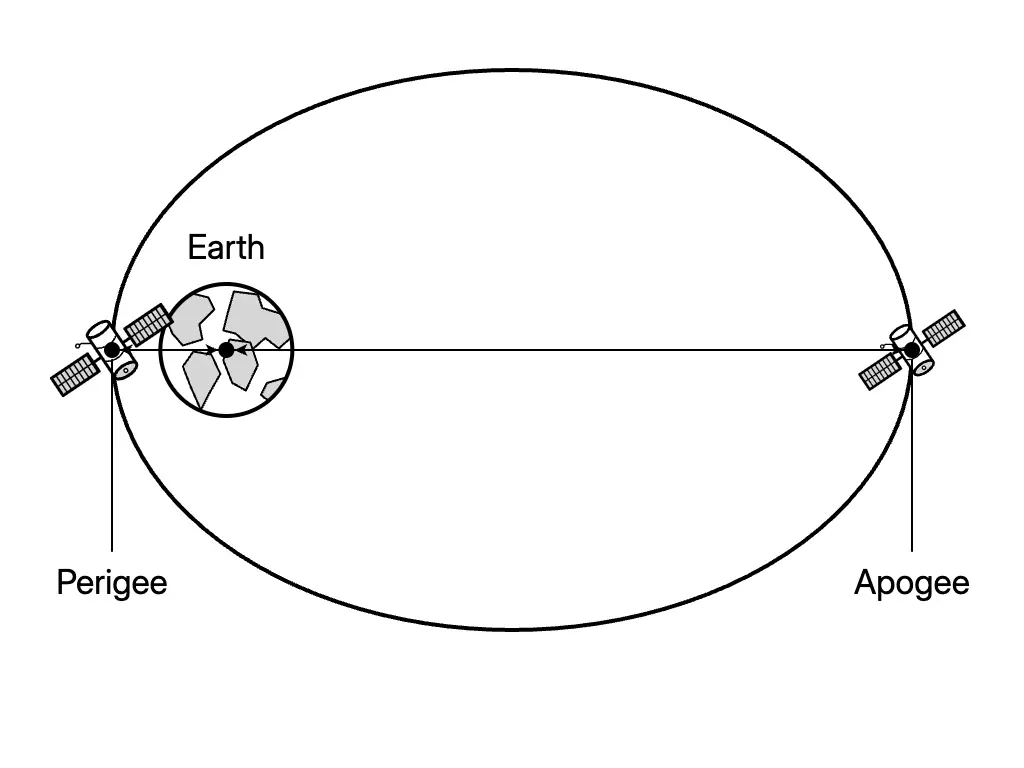
Apogee and Perigee in an Elliptical Orbit
- Apogee: position of the satellite furthest from the planet or star it encircles.
- Perigee: position of the satellite closest to the planet or star it encircles.
Relationship between Orbital Height and Satellite Velocity
| Orbit example | Orbital height | Satellite speed |
|---|---|---|
| LEO | ||
| MEO | ||
| HEO |
Relationship: the higher the orbital height of a satellite, the lower its speed must be to remain in orbit.
- Gravitational force on a satellite decreases as the satellite’s orbital height increases.
- If the speed of a satellite in a fixed orbit becomes too low, the satellite falls towards Earth.
- If its speed becomes too high, the satellite moves off into space.
Activity 9.2 — Determine the Relationship
- Gather the type or system, orbital height and speed of several satellites.
- Tabulate the data by satellite, orbit type, orbital height and satellite speed.
- Compare the data.
- Conclude the relationship: orbital height increases → satellite speed decreases.
Launch and Placement of Satellites into Orbit
A launch vehicle, made up of one or more rockets, sends a satellite or spacecraft into outer space.
Methods of Sending Launch Vehicles into Orbit
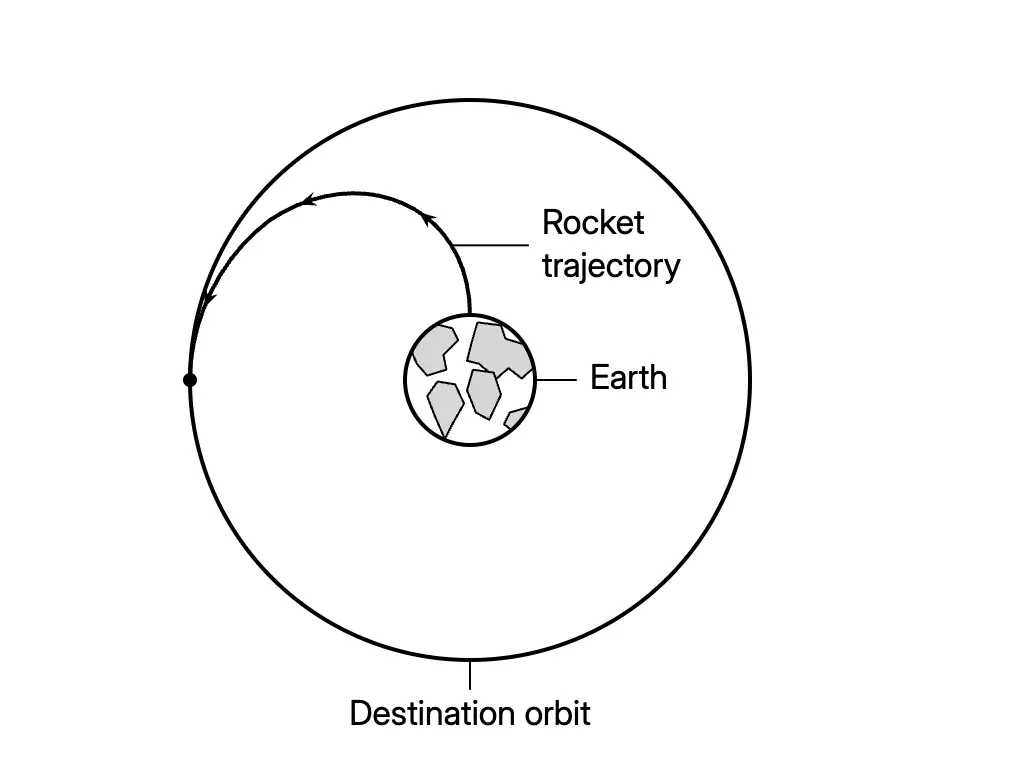
- Directly into orbit — the launch vehicle follows a rocket trajectory from Earth into the required orbit.
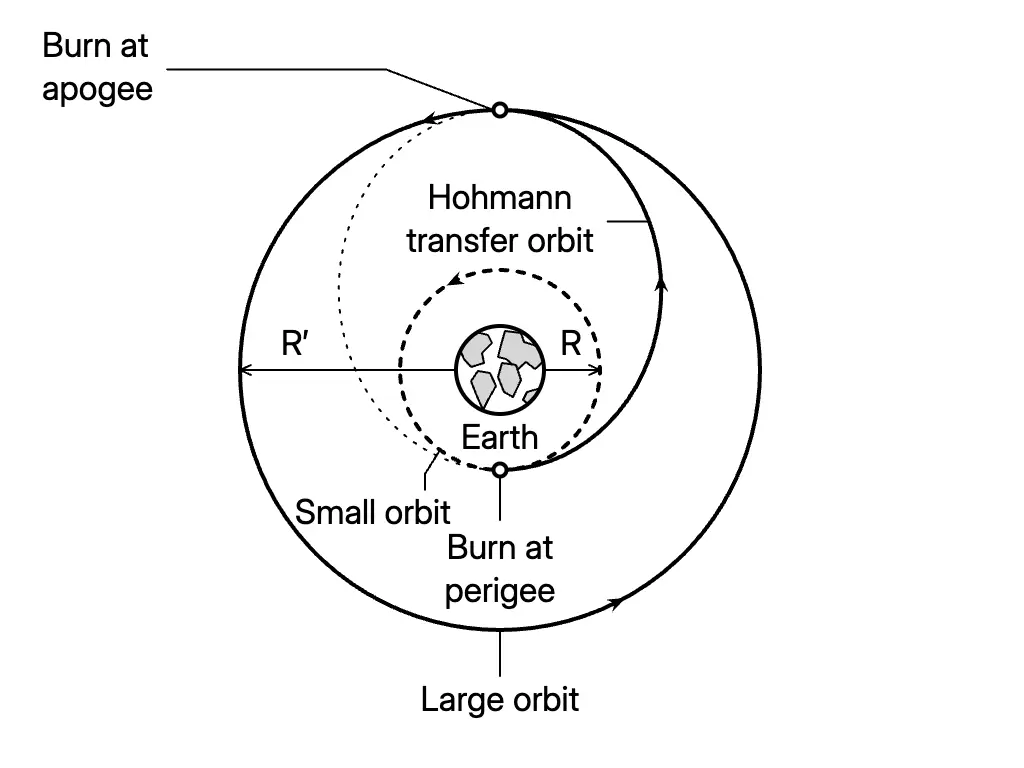
- Hohmann transfer orbit — an elliptical transfer orbit moves the launch vehicle between two orbits of different heights:
- the vehicle begins in the small orbit;
- burning at perigee places it on the Hohmann transfer orbit;
- burning at apogee places it in the large orbit.
Types of Launch Vehicles
| Launch vehicle | Key distinction |
|---|---|
| Expendable launch vehicle (ELV) | Used once |
| Reusable launch vehicle (RLV) | Can be used again |
Function of the International Space Station
The International Space Station (ISS):
- provides a place for astronaut crews to live and work in outer space;
- provides a place for astronauts to conduct scientific research in outer space;
- is the result of efforts by five space agencies: NASA (America), Roscosmos (Russia), JAXA (Japan), ESA (Europe) and CSA (Canada).
Dato’ Dr Sheikh Muszaphar Shukor Al Masrie bin Sheikh Mustapha was the first Malaysian to reach the ISS.
Zero Gravity
Zero gravity is the condition in which no significant gravitational force effect is felt.
- Astronauts at the ISS are in a floating condition because of the zero-gravity condition.
- An everyday simulation is indoor skydiving:
- a very strong upward airflow produces an upward thrust;
- the thrust is equal in magnitude to the participant’s weight but acts in the opposite direction;
- no significant gravitational force effect is felt, so the participant floats in the air.
Methods for Tracking Space Stations
Calculating the Frequency of the ISS Orbiting Earth
Use the ISS orbital height, ISS speed and radius of Earth, .
Keep all distances and speeds in consistent units before substituting values.
Tracking with a Smartphone Application
A smartphone application can display:
- the observer’s location;
- the current position of the ISS;
- the ISS orbit.
This allows the observer to determine when the ISS passes over the observer’s location.
Impact of Rapid Development in Space Technology
Increase in Space Junk
Space junk includes:
- non-functioning satellites;
- used parts of ELVs;
- satellite debris produced by collisions between satellites;
- exhausted rockets;
- other waste in space.
Effects:
- According to observations by NASA parties monitoring space junk, 95% of the thousands of man-made objects in LEO are space junk.
- More space junk causes a higher risk of collision between satellites and space junk.
- The weather satellite GOES normally changes its orbit several times to avoid collision with space junk.
Increase in Research and Development Activities
Advancement in space technology increases research and development in:
- human health;
- responses to climate change and disasters;
- new innovative technology;
- global education;
- development of the space economy.
Answer practice questions to test your knowledge
Practice