8.1 - Pressure in Fluids
Concept of Pressure in Fluids in an Enclosed System
- A fluid is a liquid or gas.
- An enclosed system is a physical system where matter cannot enter or leave the system.
- Water from the bottommost hole of a water-filled bottle shoots out the furthest because water pressure is greater at a greater depth.
- When the closed plastic bottle is compressed, water from every hole shoots an equal additional distance farther.
- The additional pressure is transmitted uniformly throughout the water and in all directions.
Pascal’s principle: The transmission of pressure exerted on a fluid (liquid or gas) in an enclosed system is uniform throughout the fluid and in all directions.
Activity 8.1: Pascal’s Equipment
Aim: To explain Pascal’s principle using Pascal’s equipment.
Apparatus: Round-bottom flask with fine pores and piston, and large beaker
- Fill the beaker with water.
- Immerse the flask and pull the piston upwards until water fills the flask.
- Remove the flask from the beaker.
- Push the piston into the flask.
- Observe and sketch the direction of water shooting from the fine pores.
Observation: Water shoots out from all the fine pores in all directions.
Explanation: Pressure exerted by the piston is transmitted uniformly throughout the water and in all directions.
Conclusion: The observation demonstrates Pascal’s principle.
Operating Principle of a Hydraulic System
- A hydraulic system transmits pressure in all directions based on Pascal’s principle.
- It produces a large output force from a small input force, enabling heavy work such as lifting a heavy load.
- It consists of two cylindrical pistons with different surface areas connected by a fluid.
- Water or oil is commonly used because it:
- has no fixed shape; and
- cannot be compressed.
- Pressure exerted by the small piston equals pressure produced at the large piston.
Force Multiplication
- The same pressure acts on both pistons.
- A large piston with a greater surface area produces a greater output force.
Example: Input force , area of small piston , area of large piston .
Thus, an input force of produces an output force of .
Applications of Pascal’s Principle in Daily Life
Hydraulic systems perform heavy work using a small force. The three applications are the hydraulic jack, hydraulic brake and dental chair.
Hydraulic Jack System
- Function: Lifts heavy loads such as cars in workshops.
- Main parts: lever, pivot, small piston, large piston, liquid reservoir, air hole, valve A, valve B and release valve.
- Repeated downward and upward movements of the lever raise the loaded large piston when the release valve is closed.
- Opening the release valve lowers the loaded large piston to its original position.
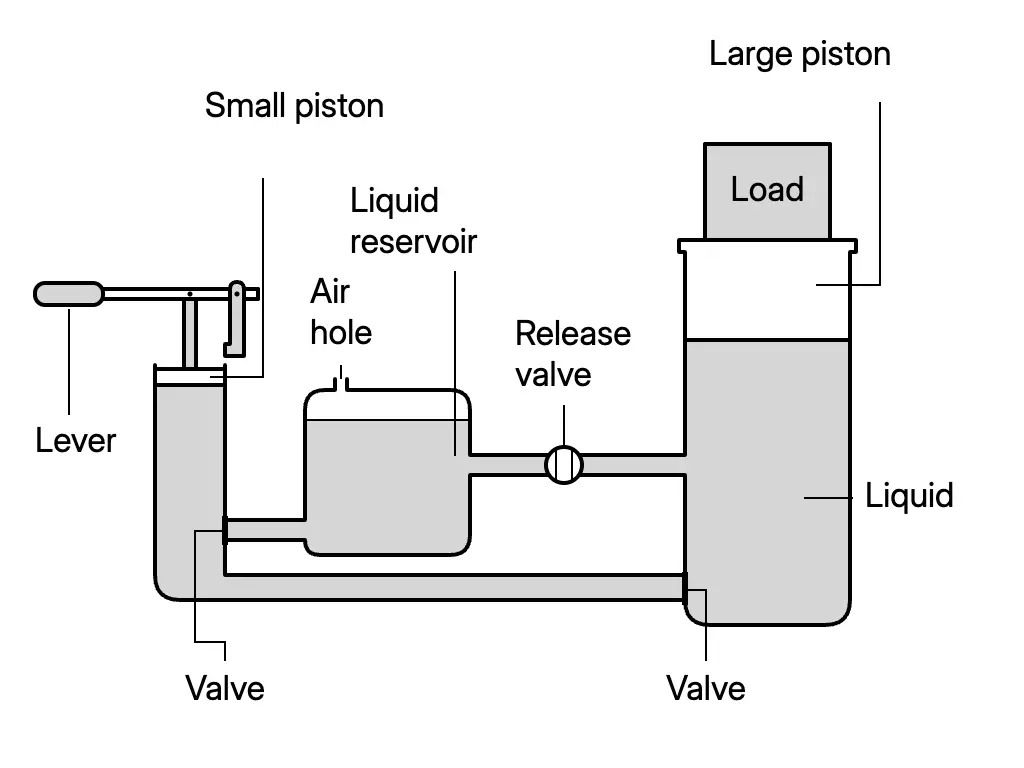
Raising the loaded large piston
- Keep the release valve closed.
- Move the lever downwards: valve A closes and valve B opens.
- The small piston exerts pressure on the liquid.
- The liquid transmits the pressure to the loaded large piston and pushes it upwards.
- Move the lever downwards and upwards repeatedly until the load reaches the desired height.
Maintaining the height of the large piston
- Move the lever upwards while the release valve remains closed.
- Valve A opens and valve B closes.
- Liquid from the reservoir flows below the small piston through valve A.
- Constant liquid pressure acts on the large piston, so its position is maintained.
Lowering the large piston
- Open the release valve: valve A opens and valve B closes.
- The loaded large piston exerts pressure on the liquid beneath it.
- The liquid flows back into the liquid reservoir through the release valve.
- The large piston returns to its original position.
Hydraulic Brake System
- Function: Slows down or stops a moving wheeled vehicle such as a car.
- The front wheels use disc brakes; the back wheels use drum brakes.
- The pressed brake pedal pushes the piston into the master cylinder and exerts pressure on the brake oil.
- The brake oil transmits this pressure uniformly through metal pipes to the brake cylinders at the front and back wheels.
- At the disc brake, the brake-cylinder piston presses the brake pad against the steel plate.
- At the drum brake, the brake-cylinder piston presses the brake shoe and brake lining against the brake drum.
- Friction slows down or stops the rotation of the wheels.
| Brake | Braking surfaces that produce friction |
|---|---|
| Disc brake | Brake pad and steel plate at the front wheel |
| Drum brake | Brake lining and brake drum at the back wheel |
Dental Chair
- Its operation is related to the hydraulic system and Pascal’s principle.
Relationship Between Fluid Velocity and Pressure
- In a fluid that is not flowing, the pressure at , and is the same.
- A Venturi tube is a non-uniform tube with a narrower centre.
- When fluid flows through the tube:
- velocity at the narrow part, , is higher than at the wider parts, and ;
- pressure at is lower than at and .
- The narrower the part of the Venturi tube, the higher the fluid velocity and the lower the fluid pressure. This is the Venturi effect.
Bernoulli’s principle: A fluid moving at a higher velocity produces a lower pressure in that region.
Activity 8.2: Venturi Tube
Aim: To explain Bernoulli’s principle using a Venturi tube.
Material: Tap water
Apparatus: Venturi tube with vertical tubes , and , rubber tube and clip
- Connect the Venturi tube to a tap and direct its outlet to a sink.
- Close the clip, turn on the tap and allow tubes , and to fill with water.
- Compare and sketch the water levels in , and .
- Open the clip so water flows continuously through the glass tube into the sink.
- Compare and sketch the water levels again.
| Condition | Observation and inference |
|---|---|
| Clip closed | Water does not flow; velocity is zero and the water levels in , and are equal, showing equal pressure. |
| Clip open | Water flows fastest through the narrow part at ; the water level at is lowest, showing the lowest pressure. |
- The pressure change at the narrower part is the Venturi effect.
- The result when water flows demonstrates Bernoulli’s principle.
Applications of Bernoulli’s Principle in Daily Life
Aerofoil-shaped Wings of an Aeroplane
- Air flows at high velocity and low pressure above the wing.
- Air flows at lower velocity and higher pressure below the wing.
- The pressure difference produces an upward lift.
- Lift is produced by the aerofoil shape and angle of attack of the wing.
Helicopter and Drone
- Airflow above the blades has high velocity and low pressure.
- Air below the blades has lower velocity and higher pressure.
- The pressure difference produces lift.
Bunsen Burner
- Gas flows at high velocity and low pressure.
- Surrounding air at higher pressure is drawn into the burner.
- The air mixes with the gas and the mixture flows upwards.
Safety Lines Near Railway Tracks
- A moving train produces high-velocity, low-pressure airflow in the space between the train and a nearby person.
- Air on the other side of the person has lower velocity and higher pressure.
- The pressure difference produces a force towards the moving train.
- Stand behind the safety line to avoid being pushed towards the train.
Activity 8.3: Studying Applications in Daily Life
- Gather information on applications of Bernoulli’s principle in sports such as sailing and windsurfing.
- Discuss the information gathered.
- Present the findings in a report.
Activity 8.4: Designing a Tool Using the Principle of Pressure in Fluids
Aim: To design a tool using the principle of pressure in fluids.
- Design a tool such as a crane that uses a hydraulic system to lift a heavy load.
- Present the design and explain how its hydraulic system functions.
Operating sequence:
Answer practice questions to test your knowledge
Practice