8.2 - Modern Periodic Table of Elements
Structure and Arrangement of Elements
- The Modern Periodic Table of Elements contains 118 elements.
- Each element entry shows its proton number, symbol, name and relative atomic mass.
- Elements are classified as metals, semi-metals or non-metals; their physical states are shown as solid, liquid or gas.
| Feature | Description |
|---|---|
| Group | A vertical column; there are 18 groups. |
| Period | A horizontal row; there are 7 periods. |
| Lanthanoid series | Elements with proton numbers 57–71, placed separately below the main table. |
| Actinoid series | Elements with proton numbers 89–103, placed separately below the main table. |
Named groups and region
- Group 1: alkali metals
- Group 2: alkaline earth metals
- Groups 3–12: transition metals
- Group 17: halogens
- Group 18: inert gases
Changes from left to right across a period
- Metallic properties decrease; non-metallic properties increase.
- Properties of oxides change from basic oxides to acidic oxides.
- Electrical conductivity decreases.
Principle of arrangement
- Elements are arranged in ascending order of proton number, from left to right and from top to bottom.
- Proton number is the number of protons in the nucleus of an atom.
Electron Arrangement of Elements
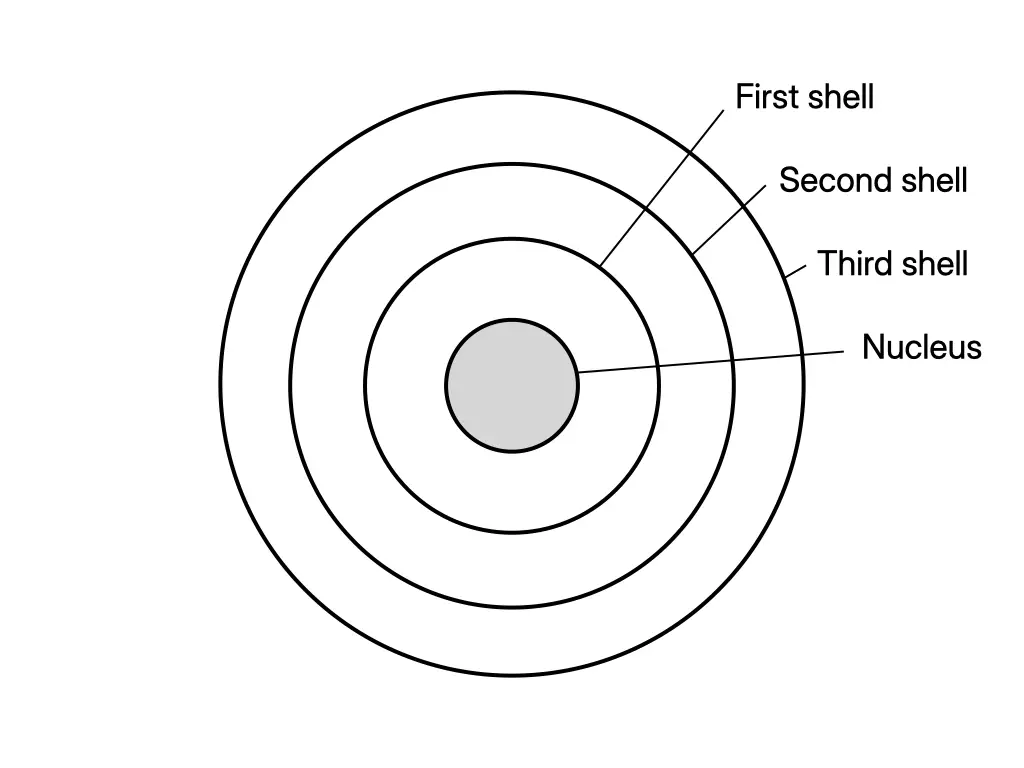
- For a neutral atom:
- Electrons are arranged around the nucleus in electron shells.
- The shell nearest to the nucleus is filled first. A new shell is occupied only after the preceding shell has been filled.
- Electron shell capacities:
| Electron shell | Maximum number of electrons |
|---|---|
| First | 2 |
| Second | 8 |
| Third | 18 |
- For atoms with proton numbers 1–20, fill 2 electrons in the first shell, 8 electrons in the second shell and 8 electrons in the third shell before starting the fourth shell.
Example: sulphur
- Proton number = 16; hence a neutral sulphur atom has 16 electrons.
- Distribution: 2 in the first shell, 8 in the second shell, 6 in the third shell.
- Electron arrangement: 2.8.6.
Electron arrangements of the first 20 elements
| Elements | Proton numbers | Electron arrangements |
|---|---|---|
| H, He | 1–2 | 1; 2 |
| Li–Ne | 3–10 | 2.1; 2.2; 2.3; 2.4; 2.5; 2.6; 2.7; 2.8 |
| Na–Ar | 11–18 | 2.8.1; 2.8.2; 2.8.3; 2.8.4; 2.8.5; 2.8.6; 2.8.7; 2.8.8 |
| K, Ca | 19–20 | 2.8.8.1; 2.8.8.2 |
Formation of Positive and Negative Ions
- Most atoms have an unstable electron arrangement and tend to form a stable electron arrangement.
- A neutral atom forms an ion by losing outermost-shell electrons to another atom or gaining outermost-shell electrons from another atom.
- This loss or gain allows the atom to achieve a stable duplet or octet electron arrangement.
| Stable arrangement | Meaning |
|---|---|
| Duplet | 2 electrons in the first shell. |
| Octet | 8 electrons in the outermost shell. |
| Ion formed | Process |
|---|---|
| Positive ion | A metal atom loses electrons. |
| Negative ion | A non-metal atom gains electrons. |
Magnesium ion,
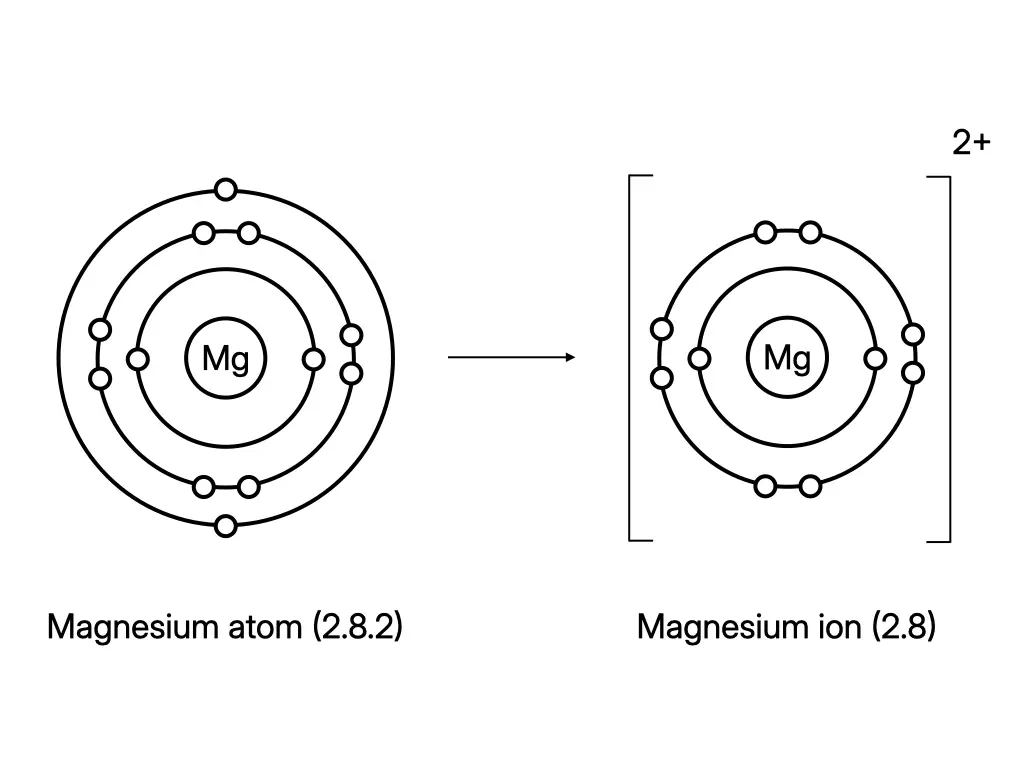
- Magnesium atom: 12 electrons; electron arrangement 2.8.2.
- Losing 2 electrons is easier than gaining 6 electrons.
- It forms a magnesium ion with electron arrangement 2.8, achieving a stable octet.
Chloride ion,
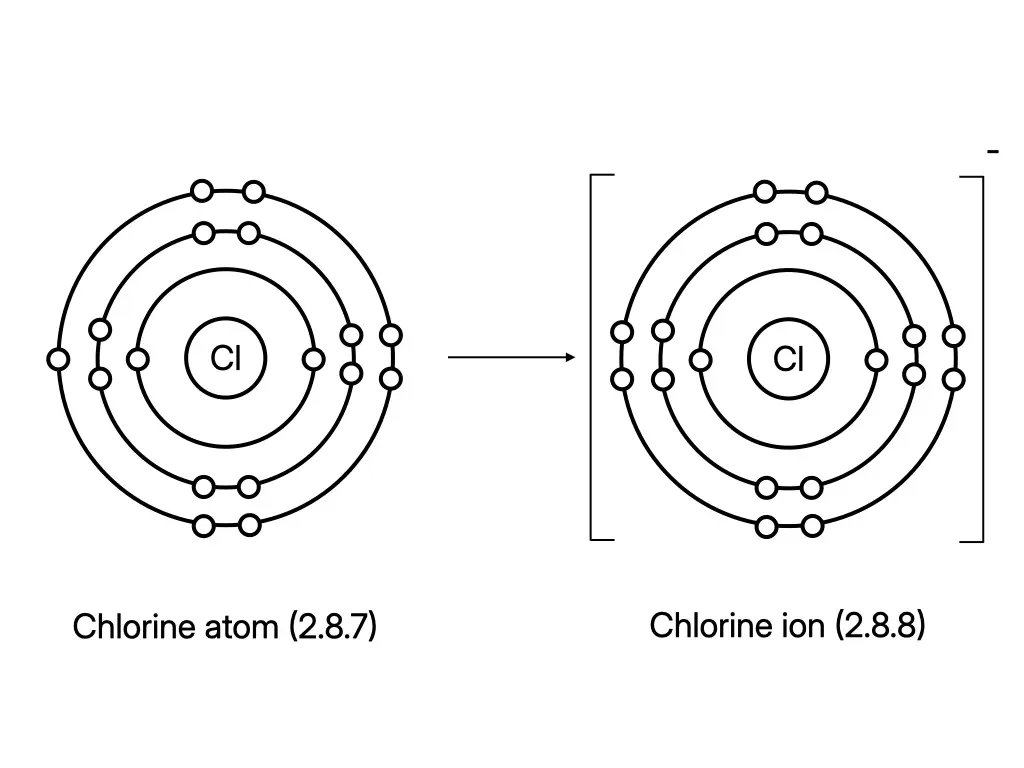
- Chlorine atom: 17 electrons; electron arrangement 2.8.7.
- It gains 1 electron and forms a chloride ion with electron arrangement 2.8.8, achieving a stable octet.
- Corrosion of a metal occurs when metal atoms form positive ions; rusting is therefore linked to ion formation.
Answer practice questions to test your knowledge
Practice