Oscillation and vibration are repeated motions about an equilibrium position along a closed path.
An oscillating or vibrating system produces waves. An iron bob oscillating at a water surface produces water waves; a vibrating tuning fork produces sound waves in air.
Wave propagation transfers energy without transferring the matter of the medium from one place to another.
A ribbon tied to a slinky spring vibrates about a fixed position while the wave travels along the spring. The ribbon does not travel with the energy.
A wave profile is the shape of the medium as the wave passes through it.
Classification of Waves
Type
Characteristics
Progressive wave
Its profile propagates with time. Water waves spreading outwards from a vibrating source are an example.
Stationary wave
Its profile does not propagate with time. It forms when two identical progressive waves travelling in opposite directions meet. Examples occur in guitar strings, ukuleles, flutes and drums.
Mechanical wave
Requires a medium; consists of vibrating particles of the medium. Examples: water, sound and seismic waves.
Electromagnetic wave
Does not require a medium; consists of oscillating electric and magnetic fields perpendicular to each other. Examples: radio waves, light and gamma rays.
Transverse and Longitudinal Waves
Type
Vibration and wave pattern
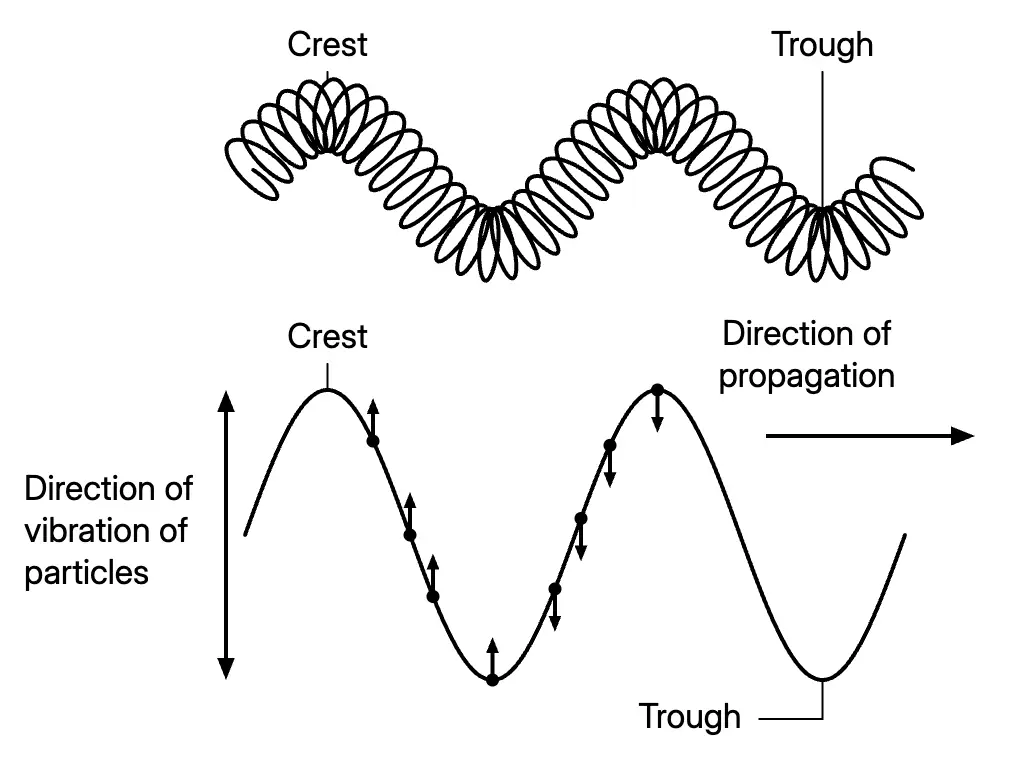
Transverse wave
Vibration is perpendicular to propagation. The pattern contains successive crests and troughs. Examples: radio, light and water waves.
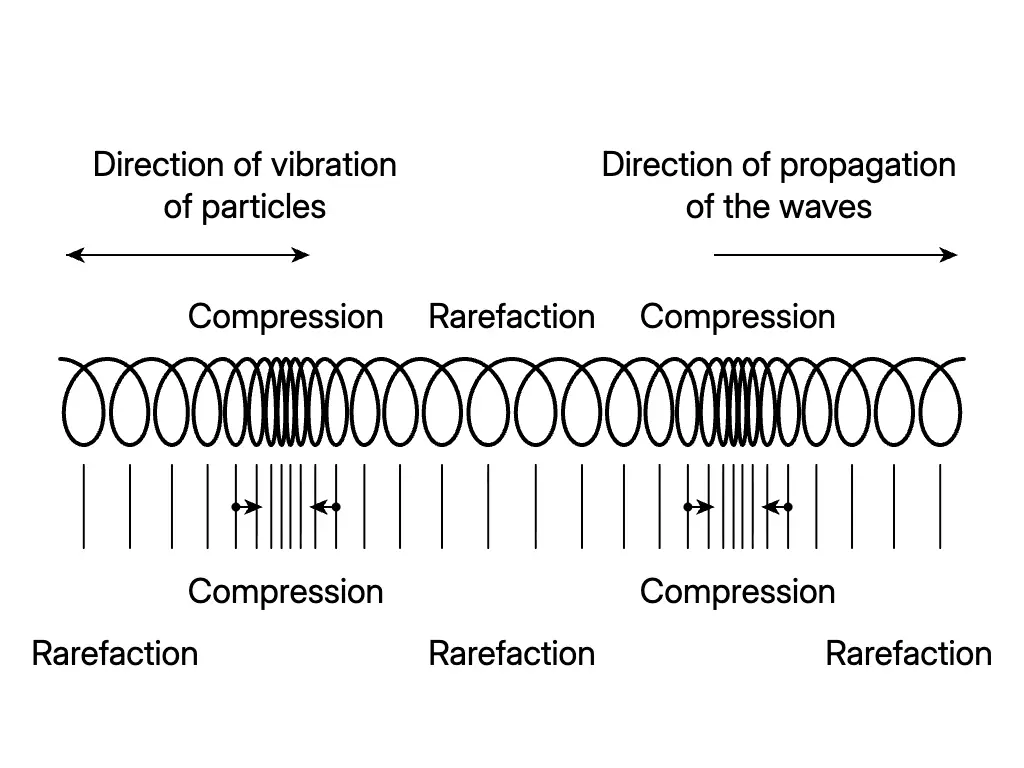
Longitudinal wave
Vibration is parallel to propagation. The pattern contains successive compressions and rarefactions. Sound waves are an example.
Moving a slinky sideways produces a transverse wave; moving it forwards and backwards produces a longitudinal wave.
Earthquakes produce transverse S-waves and longitudinal P-waves. Their speeds differ; the difference in arrival times helps determine an earthquake’s epicentre.
Transverse waveLongitudinal wave
Wave Quantities and Wave Speed
Quantity
Meaning
Amplitude, A
Maximum displacement of a particle from its equilibrium position.
Period, T
Time for a particle to complete one oscillation, or for a source to produce one complete wave.
Frequency, f
Number of complete oscillations, or waves produced by a source, in one second.
Wavelength, λ
Distance between two consecutive points in phase.
Wave speed, v
Distance travelled by the wave profile per second.
Equilibrium position is a particle’s original position before oscillation; displacement describes its distance from that position.
One wavelength is the distance between consecutive crests or consecutive troughs of a transverse wave, or consecutive compressions or consecutive rarefactions of a longitudinal wave.
In one period, the wave profile travels one wavelength:
f=T1,v=Tλ=fλ
Displacement Graphs
A displacement–time graph gives amplitude and period; calculate frequency using f=1/T.
A displacement–distance graph gives amplitude and wavelength.
Amplitude is measured from the equilibrium line to a crest or trough. The separation of consecutive corresponding points gives T on a time axis and λ on a distance axis.
Combine information from both graphs to calculate v=fλ.
For the illustrated rope-wave graphs, A=3 cm, T=0.50 s and λ=16 cm:
f=0.501=2 Hz,v=2(16)=32 cm s−1
Wave Measurements in a Ripple Tank
A ripple tank contains a transparent water tank, ripple generator, dipper, digital xenon stroboscope, mirror and glass screen, with a power source and control unit.
A plane dipper produces plane waves; a spherical dipper produces circular waves.
A stroboscope makes the wave image appear stationary when its frequency is adjusted to match the wave frequency.
Measure λ as the separation of two consecutive bright fringes on the screen. Use the wave frequency and v=fλ to find wave speed.
A handheld stroboscope can be used when a digital xenon stroboscope is unavailable.