3.3 - Chemical Formula
Meaning of a Chemical Formula
- A chemical formula represents a chemical substance using letters for atoms and subscript numbers for the number of each type of atom in an elementary entity.
- A subscript of 1 is not written.
- Examples:
- : magnesium consists of magnesium atoms.
- : each oxygen molecule has two oxygen atoms.
- : each water molecule has two hydrogen atoms and one oxygen atom.
- : aluminium and oxygen atoms occur in the ratio .
Empirical Formula and Molecular Formula
| Empirical formula | Molecular formula |
|---|---|
| Shows the simplest whole-number ratio of atoms of each element in a compound | Shows the actual number of atoms of each element in one molecule |
- For glucose, molecular formula gives the atom ratio ; dividing by 6 gives empirical formula .
- Some substances have identical empirical and molecular formulae, such as and . Others differ:
| Molecular formula | Empirical formula |
|---|---|
Determining an Empirical Formula from Composition
- Determine the mass or percentage by mass of each element.
- Convert each mass to moles of atoms using .
- Divide every mole value by the smallest value.
- If necessary, multiply all ratios by the same small integer to obtain the simplest whole numbers.
- Use the whole-number ratio as the subscripts in the empirical formula.
Example: Al combines with O.
| Element | Al | O |
|---|---|---|
| Moles of atoms | ||
| Ratio | ||
| Whole-number ratio |
Therefore, the empirical formula is .
Investigation: Empirical Formula of Magnesium Oxide
Aim: Determine the empirical formula of magnesium oxide.
Materials: A magnesium ribbon and sandpaper.
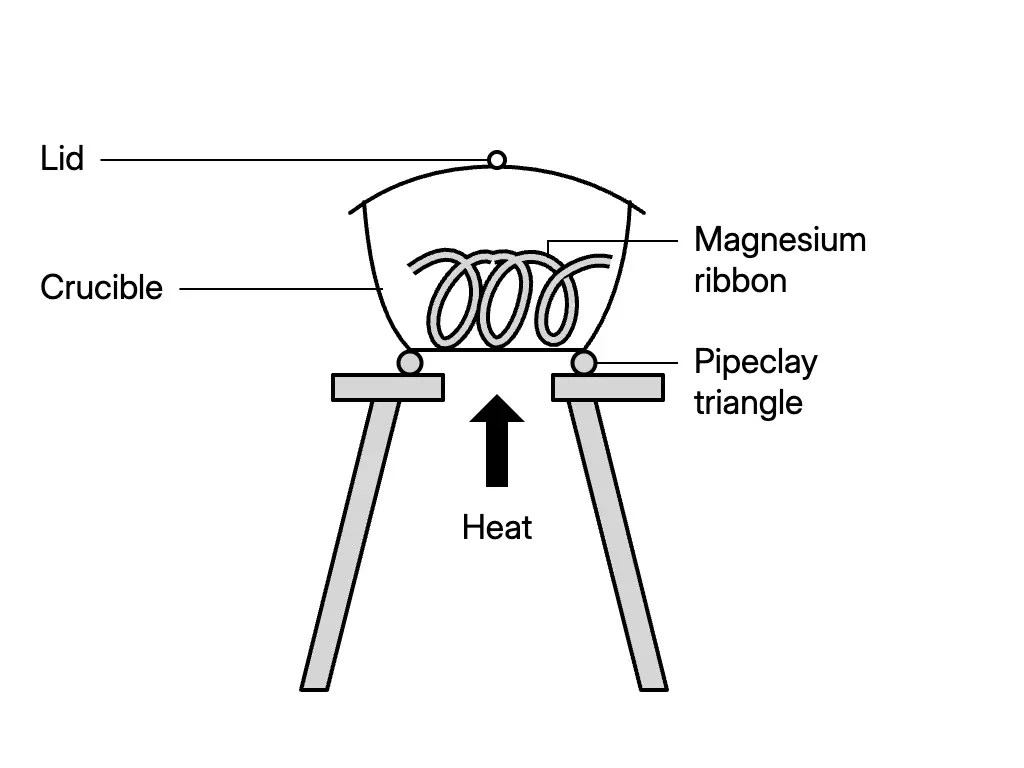
Apparatus: Crucible with lid, tongs, Bunsen burner, tripod stand, pipeclay triangle and electronic balance.
Procedure
- Weigh the crucible with its lid.
- Rub the magnesium ribbon with sandpaper until shiny, coil it and place it in the crucible.
- Weigh the crucible, lid and magnesium ribbon together; support the crucible on a pipeclay triangle on the tripod stand above the Bunsen burner.
- Heat the crucible without its lid at first. When magnesium starts to burn, replace the lid.
- Lift the lid slightly from time to time with tongs and replace it quickly.
- When burning is complete, remove the lid and heat strongly for 1–2 minutes.
- Replace the lid, cool to room temperature, and weigh the crucible, lid and contents.
- Repeat heating, cooling and weighing until a constant mass is obtained.
Recorded masses: crucible + lid; crucible + lid + magnesium; crucible + lid + magnesium oxide.
Analysis:
Convert both masses to moles and obtain the simplest ratio.
Precaution: Keep the lid on and open it only slightly to minimise escape of the white fumes.
Investigation: Empirical Formula of Copper(II) Oxide
Aim: Determine the empirical formula of copper(II) oxide.
Materials: Water, copper(II) oxide powder, zinc granules, hydrochloric acid, wooden splinter and cotton buds.
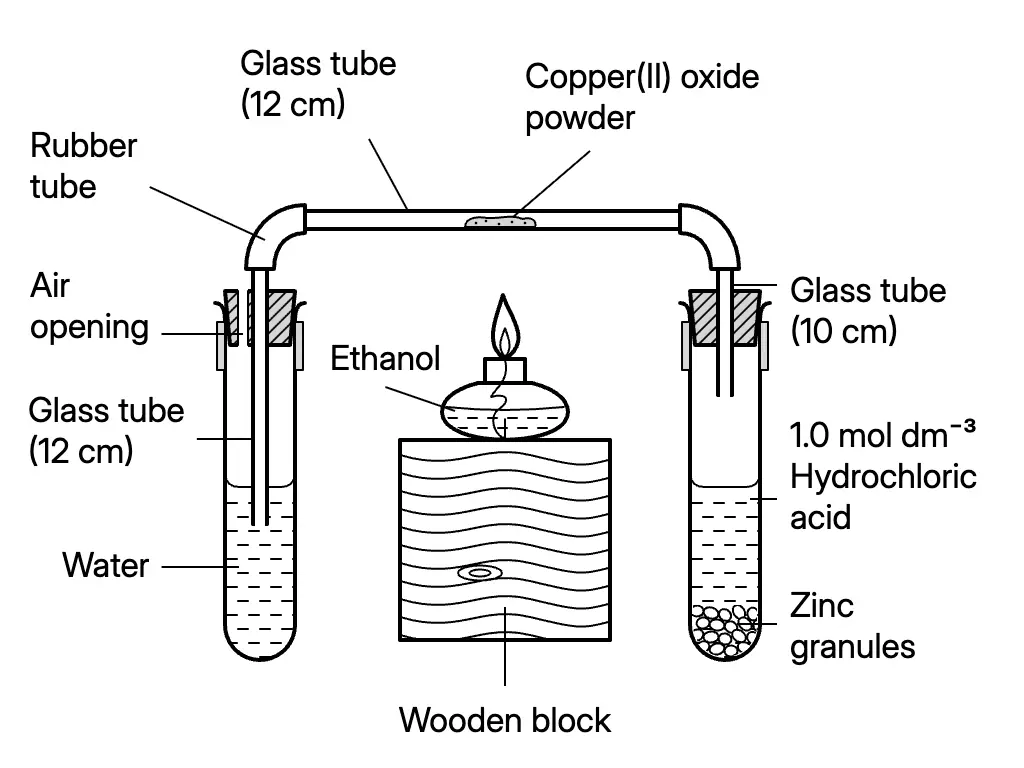
Apparatus: Boiling tubes, rubber stoppers and tubing, and glass tubes, spirit lamp, retort stands and clamps, wooden block, electronic balance and spatula.
Procedure
- Weigh the empty glass tube.
- Use a wooden splinter to move copper(II) oxide powder to the centre of the tube; weigh the tube with the powder.
- Fill one boiling tube two-thirds full with water. Fit a rubber stopper with a glass tube and clamp it to a retort stand.
- Put zinc granules in another boiling tube and add hydrochloric acid until it is one-third full. Fit a stopper with a glass tube and clamp it to another retort stand.
- Connect the tubes with rubber tubing so hydrogen passes over the copper(II) oxide and then bubbles through the water. Place the spirit lamp on the wooden block beneath the tube containing the oxide.
- Let hydrogen flow for 10 seconds, with gas bubbles escaping through the water, before heating.
- Heat the copper(II) oxide with a spirit lamp in a continuous hydrogen stream until the black powder becomes completely brown.
- Stop heating but maintain the hydrogen flow until the glass tube cools to room temperature.
- Remove water droplets from the tube end with a cotton bud, then weigh the tube and brown product.
- Repeat heating, cooling and weighing until a constant mass is obtained.
Recorded masses: glass tube; glass tube + copper(II) oxide; glass tube + copper.
Analysis:
Convert both masses to moles and obtain the simplest ratio.
Precaution: If black powder remains, move the spirit lamp beneath that part of the tube until all the powder turns brown.
- Heating a reactive metal such as magnesium in oxygen is suitable because it reacts readily.
- Copper is less reactive towards oxygen, so copper(II) oxide is reduced by hydrogen:
Determining a Molecular Formula
- A molecular formula is a whole-number multiple of its empirical formula:
- is a positive integer.
- Example: a compound has empirical formula and RMM 56. The empirical-formula mass is , so and the molecular formula is .
Determining Relative Atomic Mass from an Empirical Formula
- Example: of Y forms of ; RAM of Br is 80.
- Hence, RAM of Y is 40.
Formulae of Ionic Compounds
- Ionic compounds contain cations and anions. Their overall charge is zero.
- Common ions include:
| Cation | Formula |
|---|---|
| Sodium | |
| Potassium | |
| Aluminium | |
| Zinc | |
| Magnesium | |
| Iron(II) | |
| Iron(III) | |
| Copper(II) | |
| Calcium | |
| Silver | |
| Lead(II) | |
| Ammonium |
| Anion | Formula |
|---|---|
| Oxide | |
| Chloride | |
| Bromide | |
| Iodide | |
| Hydroxide | |
| Carbonate | |
| Nitrate | |
| Sulphate | |
| Phosphate | |
| Manganate(VII) | |
| Thiosulphate | |
| Dichromate(VI) |
Constructing an ionic formula
- Identify the cation and anion and their charges.
- Use the cross-change method: exchange the magnitudes of the cation and anion charges to obtain the numbers of ions, then reduce to the smallest whole-number ratio. Check that total positive charge equals total negative charge.
- Write the cation first and the anion second; omit charges and any subscript 1.
- Use brackets when more than one polyatomic ion is required.
Example: requires two ions, so the formula is .
Naming Chemical Compounds
- Ionic compounds: name the cation first, followed by the anion; examples include sodium chloride, zinc bromide and magnesium nitrate.
- Some metals form more than one ion. A Roman numeral identifies the charge: is iron(II), whereas is iron(III).
- Simple molecular compounds: name the more electropositive element first. The second element takes an -ide ending.
- Greek prefixes show the number of atoms: mono- 1, di- 2, tri- 3, tetra- 4, pent- 5, hex- 6, hept- 7.
- Examples: is carbon monoxide, is nitrogen dioxide, and is sulphur trioxide.
Answer practice questions to test your knowledge
Practice