1.2 - Scientific Investigation in Chemistry
Scientific Investigation and Scientific Method
- A scientific investigation uses a scientific method to solve a problem in science and generally begins by observing a problem.
- The scientific method is a systematic method used by scientists or researchers to solve science-related problems correctly.
Steps in the scientific method
- Make observations: Use sight, hearing, touch, taste or smell to gather information about an object or phenomenon.
- Make an inference: Use collected data and past experience to propose a conclusion and explanation for an event.
- Identify the problem: Ask a question based on the inference.
- Make a hypothesis: State a testable general relationship between the manipulated and responding variables that explains an event or observation.
- Identify the variables: Identify the manipulated, responding and fixed variables needed to test the hypothesis.
- Control the variables: Manipulate one variable, observe its relationship with the responding variable and keep the other variables fixed.
- Plan the experiment: Determine the materials, apparatus, procedure, data-collection method, and method for analysing and interpreting data.
- Collect data: Make observations or measurements and record them systematically.
- Interpret data: Organise and interpret the data through calculations, graphs or charts to determine relationships between variables.
- Make a conclusion: Decide from the findings whether the hypothesis is accepted or rejected.
- Prepare a report: Communicate every aspect of the experiment in detail so the findings can be shared to develop chemistry knowledge.
Experiment 1.1: Effect of Temperature on the Solubility of Salt
Aim: To study the effect of temperature on the solubility of salt in water.
Problem statement: Does the temperature of water affect the solubility of salt in water?
Hypothesis: An increase in water temperature increases the solubility of salt in water.
Variables
- Manipulated: Temperature of water
- Responding: Solubility of salt in water
- Fixed: Volume of water, mass of salt and time
Materials: Distilled water and salt.
Apparatus: beaker, measuring cylinder, thermometer, electronic scale, glass rod, Bunsen burner, stopwatch, wire gauze and tripod stand.
Apparatus arrangement: Place the beaker on wire gauze supported by a tripod stand above the Bunsen burner. Use the thermometer to measure the water temperature and the glass rod to stir the salt and water.
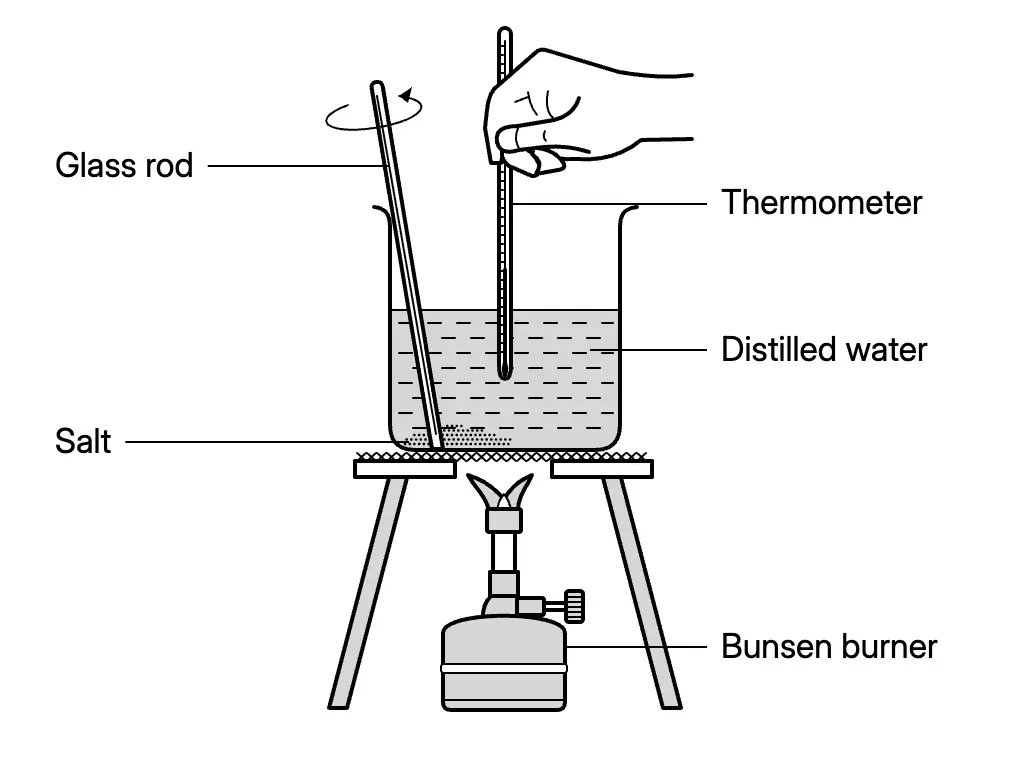
Procedure
- Measure of distilled water at with a measuring cylinder and pour it into a beaker.
- Add of salt and stir with a glass rod for 2 minutes.
- Observe the solubility of the salt.
- Repeat steps 1–3 using distilled water heated to and .
- Record the observations for all three temperatures in a table.
Data interpretation and conclusion: The observations identify the temperature at which all the salt dissolves. The conclusion states the experimental findings and whether the hypothesis is accepted or rejected.
Answer practice questions to test your knowledge
Practice