2.1 - Cell Structure and Function
Cells are the basic units of all living things.
Preparing and Examining Cell Slides
Plant Cells
- Remove the translucent epidermis from the inner surface of an onion scale leaf.
- Place the epidermis in a drop of distilled water on a glass slide.
- Lower a cover slip at an angle of 45° using a mounting needle. Ensure that the epidermis is not folded and that no air bubbles are trapped.
- Use the irrigation technique to stain the specimen: place a drop of iodine solution at one side of the cover slip and draw it across with filter paper at the opposite side.
- Absorb excess iodine solution and distilled water with filter paper.
- Examine the slide first with a low-power objective lens and then with a high-power objective lens.
Animal Cells
- Gently scrape the inside of the cheek with a blunt toothpick.
- Transfer the scraping into a drop of distilled water on a clean glass slide and cover it with a cover slip.
- Stain the cheek cells with methylene blue solution using the irrigation technique.
- Examine the cells through a light microscope.
Components of Animal and Plant Cells and Their Functions
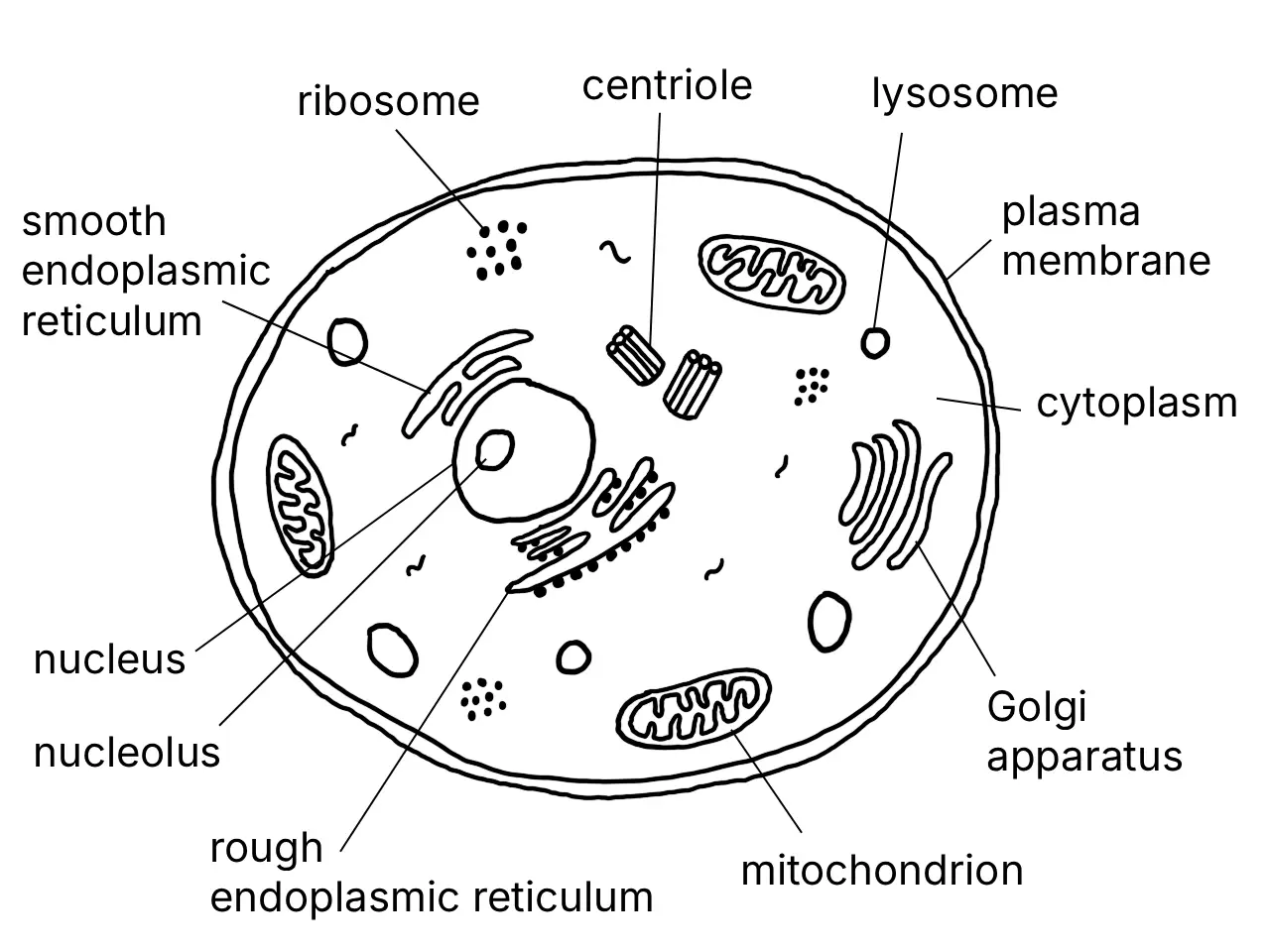
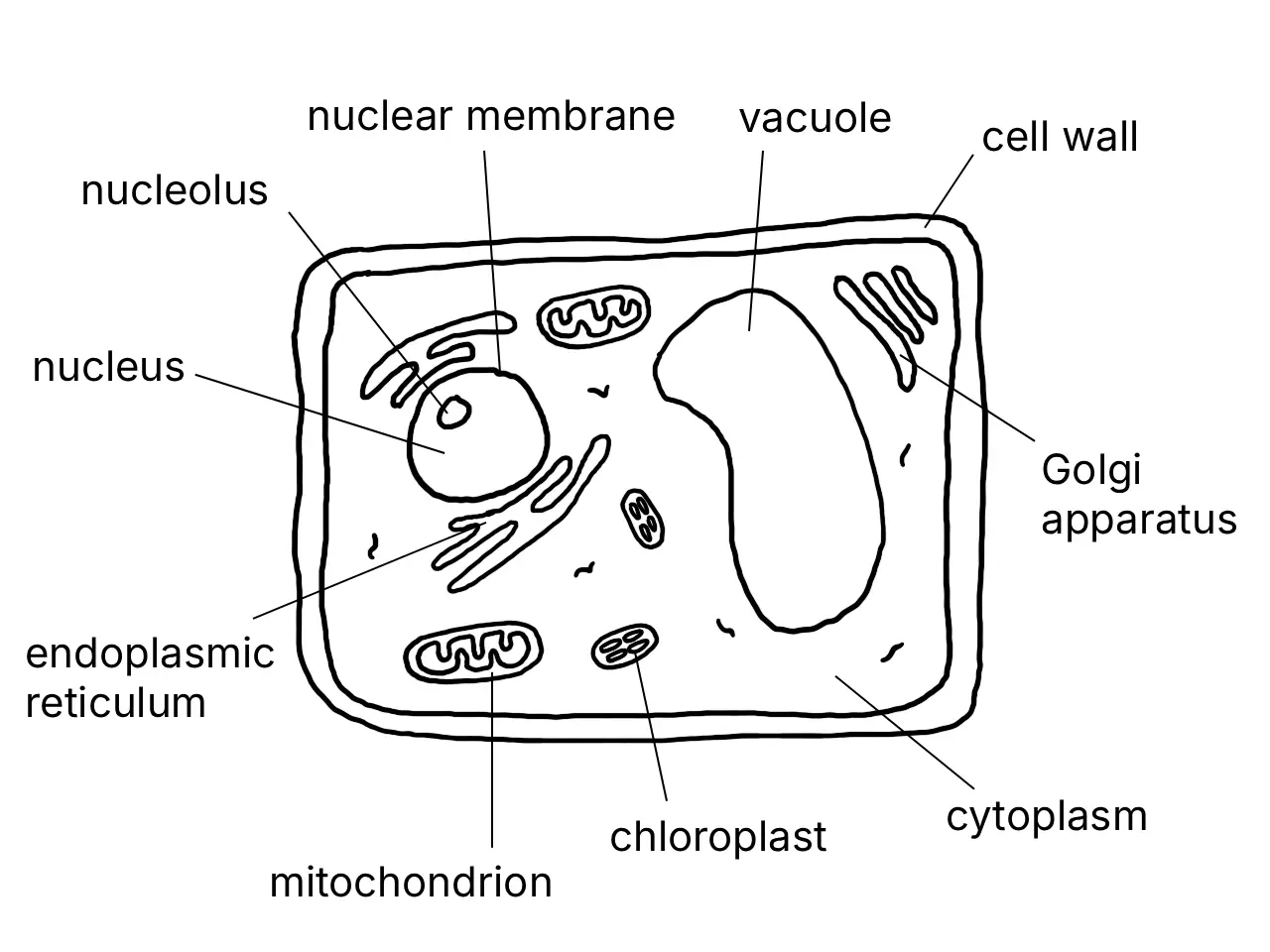
Plasma Membrane
- Characteristics:
- Outer membrane that surrounds the entire content of a cell.
- Made of proteins and phospholipids.
- Thin, elastic and partially permeable.
- Functions:
- Separates the cell content from the external environment.
- Controls the movement of substances into and out of the cell.
- Allows the exchange of nutrients, respiratory gases and waste materials between the cell and its surroundings.
Cell Wall
- Characteristics:
- Strong and rigid outer layer made of cellulose.
- Fully permeable.
- Functions:
- Maintains the shape of plant cells.
- Provides mechanical support to plant cells.
Cytoplasm
- Characteristics:
- Jelly-like substance that contains the cell components.
- Contains organic compounds such as proteins, lipids and carbohydrates, as well as inorganic compounds such as potassium ions.
- Functions:
- Acts as a medium for biochemical reactions in cells.
Nucleus
- Characteristics:
- The largest component in the cell.
- Spherical or compressed and enclosed by a nuclear membrane with many pores.
- Contains chromosomes, a nucleolus and nucleoplasm.
- Functions:
- Controls all cell activities.
- Chromosomes contain deoxyribonucleic acid (DNA), which determines cell characteristics and metabolic function.
Mitochondrion (Plural: Mitochondria)
- Characteristics:
- Rod-shaped or spherical.
- Has a smooth outer membrane and a folded inner membrane.
- Contains enzymes involved in cellular respiration.
- Functions:
- Generates energy through glucose oxidation during cellular respiration.
- Releases energy in the form of adenosine triphosphate (ATP) molecules for use by cells.
Ribosome
- Characteristics:
- Small, compact and spherical granules made of protein and ribonucleic acid (RNA).
- Found freely in the cytoplasm or on the surface of the rough endoplasmic reticulum.
- Function: Site of protein synthesis.
Endoplasmic Reticulum
- Characteristics:
- A system of interconnected folded, flattened sacs.
- Its membrane is continuous with the nuclear membrane.
- Rough endoplasmic reticulum has ribosomes attached to its surface; smooth endoplasmic reticulum does not.
- Functions:
- Acts as a transport system within the cell.
- Provides a wide surface for enzyme attachment and biochemical reactions.
- Rough endoplasmic reticulum transports proteins synthesised by ribosomes.
- Smooth endoplasmic reticulum synthesises and transports glycerol and lipids, and detoxifies drugs and metabolic by-products.
Golgi Apparatus
- Characteristics:
- A stack of parallel flattened sacs, each coated by a single membrane.
- New membrane is added at one end, while vesicles bud off from the other end.
- Function: Processes, modifies, packs and transports chemicals such as proteins, carbohydrates and glycoproteins.
Lysosome
- Characteristics:
- Small spherical sac enclosed by a single membrane.
- Contains hydrolytic enzymes.
- Functions:
- Hydrolyses complex organic molecules such as proteins, nucleic acids and lipids.
- Breaks down bacteria and components of damaged cells.
Centriole
- Characteristics:
- Small cylindrical components that exist in pairs in animal cells.
- Made of a complex arrangement of microtubules.
- Absent from plant cells.
- Function: Forms spindle fibres during cell division in animal cells.
Chloroplast
- Characteristics:
- Oval-shaped and consists of two layers of membrane.
- Contains chlorophyll pigments in the grana that give plants their green colour.
- Function: Chlorophyll absorbs sunlight and converts it to chemical energy during photosynthesis.
Vacuole
- Characteristics:
- A sac filled with cell sap.
- Surrounded by a semi-permeable membrane called the tonoplast.
- Cell sap contains water, organic acids, sugars, amino acids, enzymes, mineral salts, oxygen, carbon dioxide and metabolic by-products.
- Plant cells have large vacuoles; animal cells have small vacuoles.
- Functions:
- Water is absorbed into a plant-cell vacuole and the cell becomes turgid.
- In unicellular organisms, the contractile vacuole is involved in osmoregulation and excretion.
Comparison between Animal Cells and Plant Cells
Similarities
- Both have a nucleus, cytoplasm, plasma membrane, Golgi apparatus, mitochondria, ribosomes and endoplasmic reticulum.
Differences
| Animal Cells | Plant Cells |
|---|---|
| Do not have a fixed shape. | Have a fixed shape. |
| Do not have a cell wall. | Have a cell wall. |
| Do not have chloroplasts. | Have chloroplasts. |
| Have no vacuoles or have small vacuoles. | Have large vacuoles. |
| Store carbohydrates as glycogen. | Store carbohydrates as starch. |
| Have centrioles. | Do not have centrioles. |
Answer practice questions to test your knowledge
Practice