Immunity in Humans
11.1 - Body Defence
Introduction to Human Immunity
Key Definitions
- Pathogen: A microorganism that causes diseases. Examples include bacteria, viruses and parasites.
- Antigen: A foreign particle that enters the body and stimulates the immune response.
- Antibody: A protein found on the lymphocyte surface or released by lymphocytes into the blood plasma.
- Immune response: The interaction between antibodies and antigens that causes antigens to be destroyed.
- Immunity: The body’s ability to fight infections caused by pathogens or other foreign objects through specific attacks on the pathogens.
Three Lines of Defence in Humans
- First line: Non-specific physical and chemical defences that prevent pathogens from entering the body.
- Second line: Non-specific fever, phagocytosis and inflammation.
- Third line: Specific immune response of lymphocytes through antibodies and memory cells.
First Line of Defence
- Skin:
- Tough and difficult for microorganisms to penetrate.
- Continuous shedding of dead skin cells makes microorganism growth difficult.
- Sebum contains oil and acid that prevent microorganism growth.
- Sweat contains lysozyme that breaks down the cell wall of some bacteria.
- Lysozyme: An antimicrobial protein in tears, nasal mucus and saliva that dissolves and destroys some bacteria.
- Mucous membrane: Lines the respiratory tract and secretes mucus containing lysozyme, which destroys bacteria in inhaled air.
- Blood clotting mechanism: Prevents bacteria from entering through wounds.
- Hydrochloric acid: Destroys bacteria in food and drinks in the stomach.
Second Line of Defence
- Fever: Increases phagocytic activity and fights microorganisms that infect the body.
- Phagocytes: Leucocytes that carry out phagocytosis; neutrophils and monocytes are phagocytes.
- Phagocytosis: The trapping and digestion of microorganisms or other particles, such as dead cells, by phagocytes.
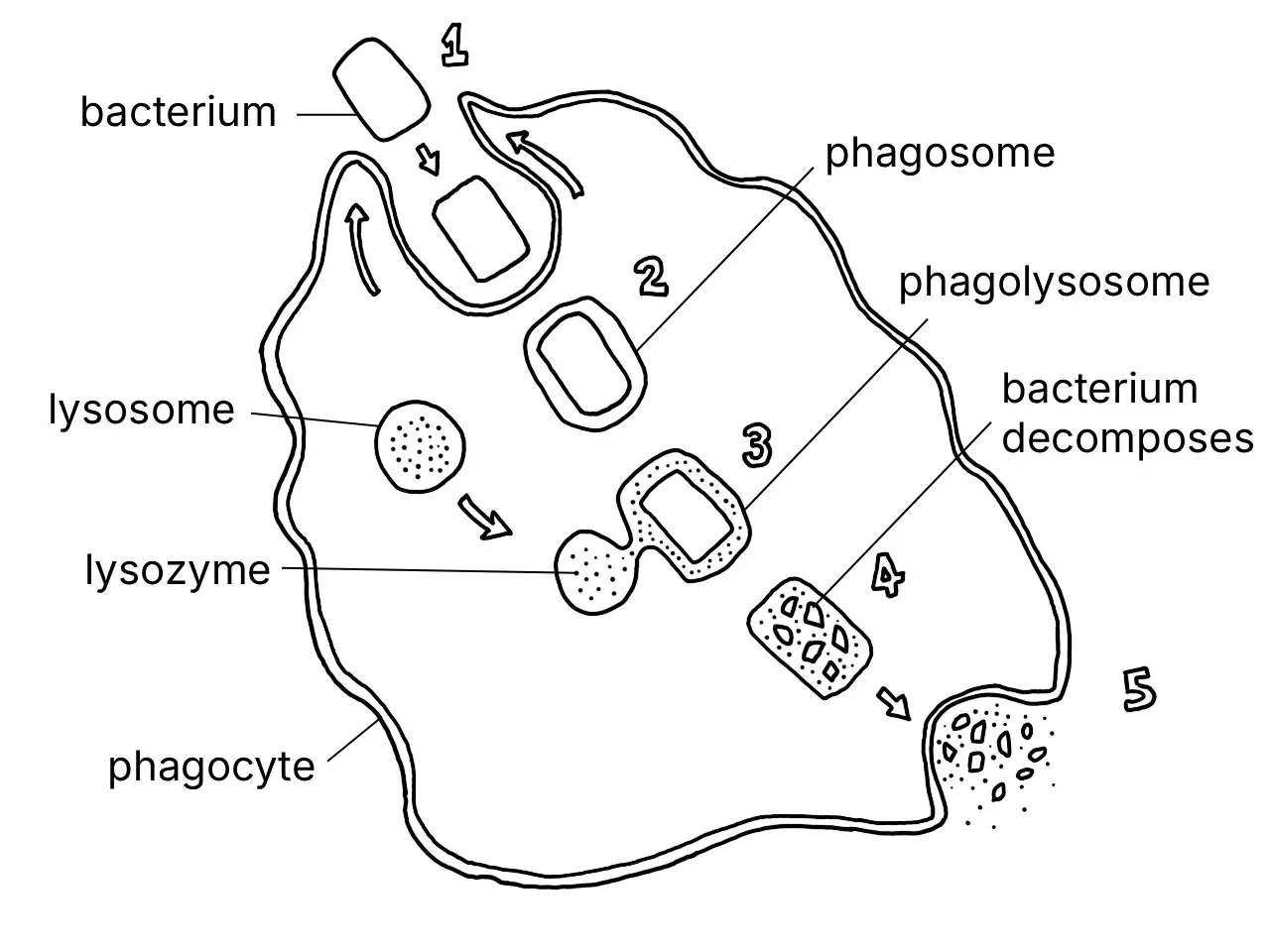
- Stages of phagocytosis:
- The phagocyte extends its pseudopodium towards a bacterium and envelops it.
- Bacterial ingestion forms a phagosome.
- The phagosome combines with a lysosome, which secretes lysozyme into the phagosome.
- Lysozyme destroys the bacterium in the phagosome.
- The phagocyte expels the remains of the digested microorganism.
- Inflammation: An immediate response that destroys and neutralises the harmful actions of microorganisms and toxins at the early stage of infection. The area swells, turns red and feels painful.
- Inflammatory response:
- Damaged tissue releases histamine, stimulating an immediate inflammatory response.
- Histamine expands blood capillaries, increases blood flow and increases capillary permeability to phagocytes; phagocytes and clotting factors accumulate at the infected area.
- The blood clotting mechanism is triggered.
- Phagocytes carry out phagocytosis.
Third Line of Defence
- Activated when pathogens overcome the second line of defence.
- Lymphocytes formed in lymph nodes produce antibodies.
- Antibody action is specific: each antibody combines with only one type of antigen.
- Lymphocytes accumulate in lymph nodes to destroy antigens and foreign particles, causing the lymph nodes to swell.
- Macrophages in lymph nodes destroy bacteria, dead tissues and foreign particles through phagocytosis.
- Lymphocytes are divided into T lymphocytes and B lymphocytes.
- T lymphocytes attack cells infected by pathogens and stimulate B lymphocytes to produce memory cells.
- If the same pathogen attacks again, memory cells are stimulated to produce antibodies immediately.
Answer practice questions to test your knowledge
Practice